

Digital Sabbath: Finding Rest in a Screen-Obsessed World
NOVEMBER 25, 2025

The Value of Science Within a Christian Worldview
Christianity has a long tradition of viewing the natural world as God’s creation, something orderly, intelligible, and worthy of exploration. From Augustine to Aquinas, Christian thinkers maintained that the universe reflects divine rationality; therefore, studying nature is a way of appreciating God’s work. Science in this sense becomes a tool that helps believers understand how the world works, while Scripture reveals why it exists and who is behind it. This distinction—methodological vs. theological explanation—has allowed many Christian traditions to embrace scientific discovery without abandoning core doctrines.
Historical Examples of Christian Scientists
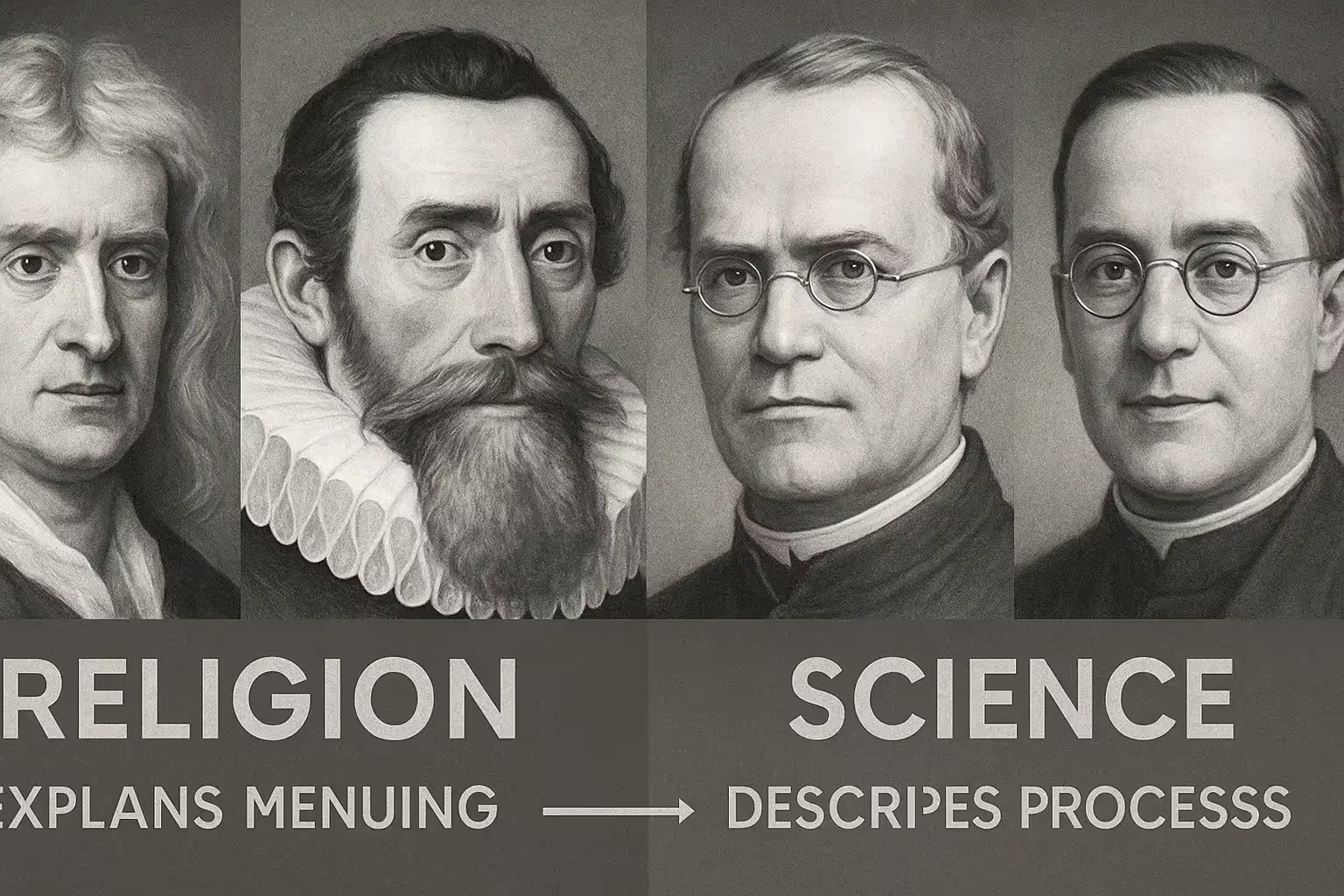
Many foundational figures in Western science were committed Christians. Isaac Newton, who transformed physics, wrote extensively on theology. Johannes Kepler saw his astronomical work as “thinking God’s thoughts after Him.” Gregor Mendel, the father of genetics, was an Augustinian monk. Georges Lemaître, a Catholic priest, proposed the Big Bang model. Their example shows that scientific inquiry and Christian faith need not stand in opposition. Historical research supports this coexistence, noting that religious institutions, especially the Church, played a significant role in the development of universities and early science (source: Stanford Encyclopedia of Philosophy).
Main Positions in the Creation–Evolution Landscape
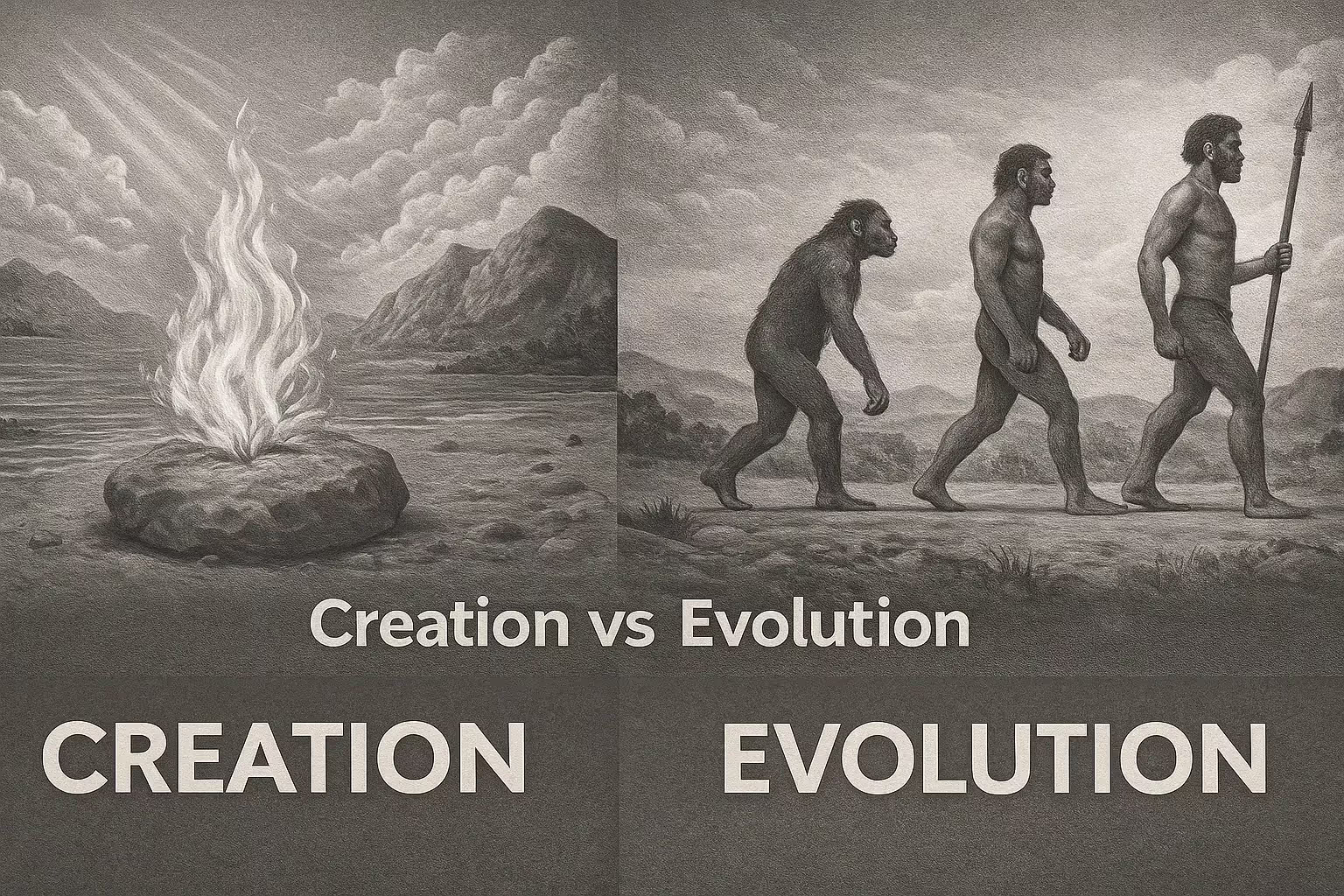
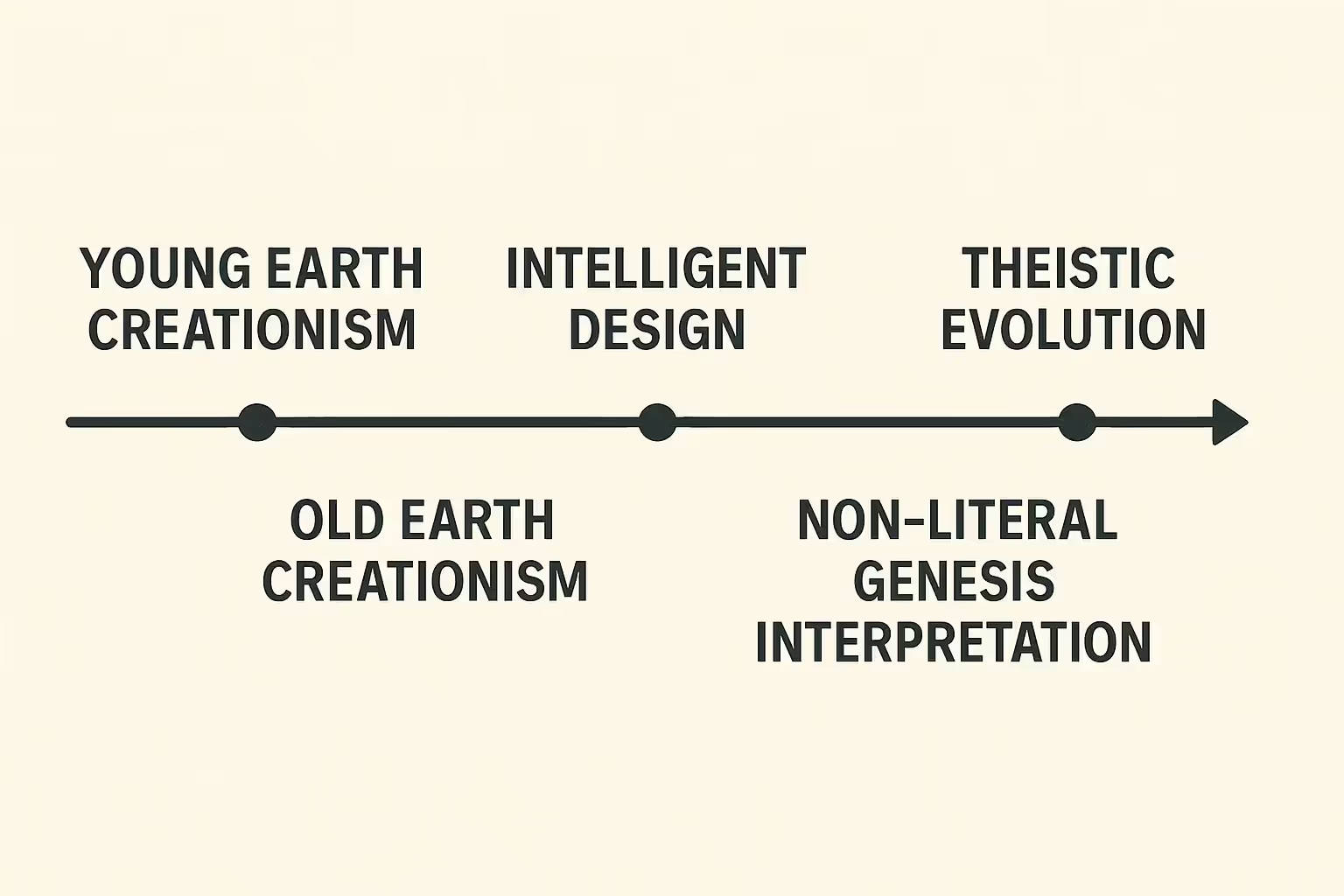
Within Christianity, there is no single unified view. Instead, believers hold a spectrum of positions: Young Earth Creationism (YEC) interprets Genesis literally and argues for a young Earth (6–10k years). Old Earth Creationism (OEC) accepts geological and cosmological evidence for an ancient universe but maintains distinct acts of divine creation. Intelligent Design (ID) argues certain biological structures are best explained by intelligent agency rather than unguided processes. Theistic Evolution (Evolutionary Creation) accepts evolutionary science fully but views God as sovereign over natural processes. Non-literal literary readings of Genesis see Genesis as a theological text about God, creation’s goodness, and human purpose rather than a scientific manual. These positions reflect different hermeneutical (interpretive) approaches and different ways of integrating scientific discoveries with Scripture. The range itself illustrates that Christianity does not mandate a single scientific stance.
Finding a “Science–Bible Harmony” Without Oversimplification
To many believers, the challenge is not choosing science or Scripture, but understanding how truth from both domains can coexist. Some Christians emphasize that Genesis reveals ultimate truths—God as Creator, humanity made in His image, creation’s goodness—while leaving room for scientific mechanisms. This approach follows Augustine’s early teaching that Genesis should not be read in a way that contradicts observable reality, lest believers expose Christian faith to ridicule by insisting on incorrect interpretations of Scripture (source: Augustine, The Literal Meaning of Genesis). In this sense, science–Bible harmony is not forced alignment but a thoughtful understanding of the different questions science and Scripture answer: science asks by what processes did life develop, while Scripture asks who created life and what is our purpose.
What Are Faith and Reason—And Where Do They Overlap?
Reason relies on observable evidence, logical inference, and testable hypotheses. Faith, in a Christian sense, is trust in God based on revelation, history, and personal experience. But these are not mutually exclusive. Scripture presents faith as grounded in reasoned belief: “Always be prepared to give an answer… for the hope that you have” (1 Peter 3:15). This implies engagement with rational argument, not blind acceptance. Christian philosophers such as Alvin Plantinga argue that belief in God can be “properly basic,” meaning rational even without empirical proof. Yet faith also welcomes scientific knowledge, which expands understanding of God’s world.
Epistemological Foundations: Why Faith Is Not Anti-Scientific
Several principles make faith compatible with scientific reasoning: science is limited to natural explanations and cannot address metaphysical claims like God’s existence or purpose. Christianity asserts that creation is orderly, which makes science possible; without consistent laws, experimentation would be meaningless. Faith provides a moral and philosophical framework for why truth matters and why the universe is intelligible. Reason can evaluate evidence, while faith provides motivations and values that guide its use. Historically, many conflicts arise not from science itself but from interpretations of science or interpretations of Scripture. Recognizing the limits and strengths of each helps avoid unnecessary opposition (source: AAAS Dialogue on Science, Ethics, and Religion).
Common Doubts: Evolution, Age of the Earth, Scientific Authority
Believers often encounter questions like: If evolution is true, does that undermine Adam and Eve? If the universe is billions of years old, how does that align with Genesis? If science explains so much, is faith still needed? These doubts are understandable. Science is powerful and persuasive because it provides reliable models of natural processes. But doubts often arise from assuming science must answer theological questions or that Scripture must answer scientific ones.
Practical Steps for Engaging Doubt Constructively
Doubt can be approached constructively through several practices. First, distinguish essentials from non-essentials. Christianity stands on central doctrines such as Christ’s resurrection, salvation through grace, and the reality of God, not on a specific chronology of creation. Second, engage with reputable scholarship. Many Christian scientists offer thoughtful integration of faith and science, for example Francis Collins in The Language of God, John Polkinghorne’s works on science and theology, and resources from the BioLogos Foundation (BioLogos). Third, embrace dialogue, not fear; doubt can lead to deeper faith when explored honestly. Fourth, seek community: discussions with pastors, scientists, and fellow believers help clarify questions. Fifth, pray and reflect; Christian tradition teaches that intellectual struggle can coexist with spiritual growth. Doubt, approached wisely, becomes a catalyst for deeper trust and greater understanding.
Four Ways People Typically See the Science–Faith Relationship
Across academic and Christian literature, there are four main models. Conflict sees science and faith as incompatible, typically held by strict naturalists or strict literalists. Independence claims that science and faith address different realms—facts vs. values, mechanisms vs. meaning—and avoids conflict but may limit integration. Dialogue suggests that science and faith can inform each other, discussing where their questions overlap. Integration proposes that science and faith form a coherent whole; examples include theistic evolution and natural theology. Most Christian scholars today gravitate toward dialogue or integration, recognizing that both science and theology describe reality from different but complementary angles.
Practical Guidance for Christians Engaged in Science
A practical model of science and faith compatibility includes several guiding principles. Affirm that all truth is God’s truth; if scientific findings are true, they ultimately reflect God’s creation. Use Scripture responsibly, interpreting biblical genres correctly; Genesis contains poetry and theology, not laboratory descriptions. Maintain intellectual humility; science evolves and interpretations of Scripture can deepen. Live with mystery where necessary; not all tension must be resolved immediately. Pursue science as worship; studying creation can be an act of loving God with the mind, in line with the command to love God with all your heart, soul, and mind. This integrative mindset helps believers thrive both spiritually and academically.
The supposed opposition between science and Christianity often arises from misunderstandings, selective interpretations, or cultural narratives—not from inherent contradiction. When approached with humility, intellectual honesty, and a commitment to truth, science and faith enrich one another. Christian tradition affirms a Creator who made an orderly world; science seeks to understand that order. Faith provides meaning, morality, and purpose; science provides mechanisms, models, and methods. Together, they offer a fuller picture of reality. For Christians today navigating questions about evolution, cosmology, or scientific authority, the path forward is not fear but informed engagement. Dialogue, careful interpretation, and trust in God’s sovereignty enable believers to affirm both Scripture and scientific discovery. Science and faith compatibility is not only possible—it is deeply enriching for those willing to explore both with openness and integrity.
Can someone be both a committed Christian and a scientist?
Yes. Many leading scientists are Christians or hold religious beliefs. Faith and empirical investigation occupy different but complementary domains. The historical record strongly contradicts the myth that science emerged in spite of Christianity (source: Stanford Encyclopedia of Philosophy).
What should I do if science seems to contradict the Bible?
First, examine whether the contradiction lies between science and Scripture, or between scientists’ interpretations and your interpretation. Often, the tension lies in hermeneutics, not in the Bible itself. Seek reputable theological commentary and scientific sources, and be open to the possibility that both your understanding of science and your understanding of Scripture may need refinement.
Is accepting evolution the same as rejecting God?
No. Many Christians accept evolution as a natural process guided by God. Evolutionary creation is a well-established theological position held by scholars, pastors, and scientists worldwide (source: BioLogos). Accepting a scientific account of biological change does not require abandoning belief in a Creator who purposes and sustains the universe.
NOVEMBER 25, 2025
NOVEMBER 25, 2025
NOVEMBER 25, 2025
NOVEMBER 25, 2025
NOVEMBER 25, 2025