

Finding a Healthy Church: A Complete Guide to Choosing a Faithful and Welcoming Community
NOVEMBER 25, 2025
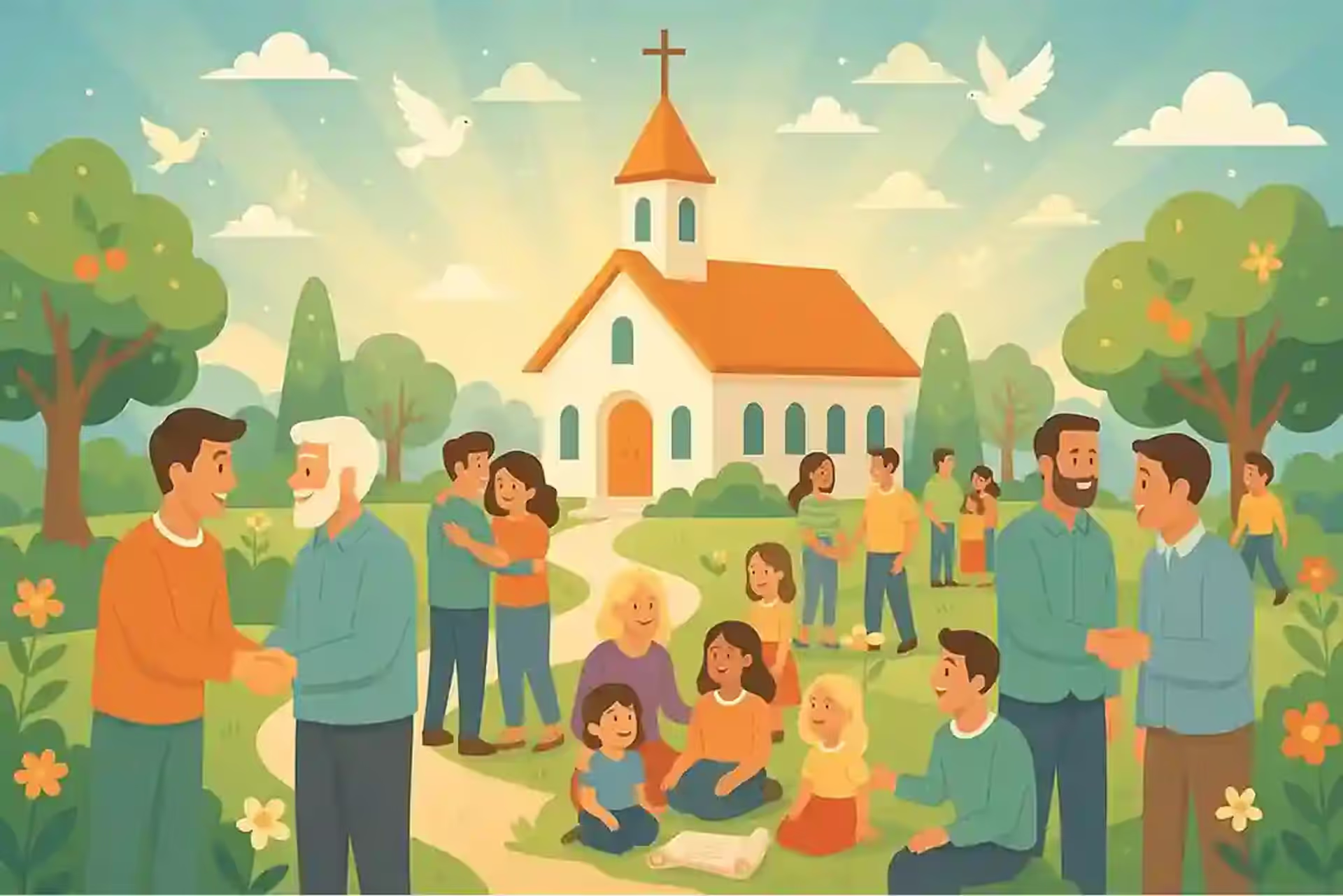
Sarah Mitchell sat in her living room scrolling through her phone, surrounded by 847 social media connections yet feeling profoundly alone. The pandemic had accelerated a trend already underway—the steady dissolution of face-to-face community into pixels and profiles. Her church attendance had become sporadic, then occasional, then nonexistent over the past eighteen months. She told herself she was still connected through livestreams and online groups, but something essential was missing that virtual interaction could never quite replicate. The isolation gnawed at her faith in ways she hadn't anticipated, creating spiritual vulnerability she didn't recognize until doubt began creeping in through the cracks that community once filled.
This story repeats itself across America with alarming frequency. We live in an age of unprecedented connectivity yet profound disconnection, where digital networks promise belonging while delivering isolation that slowly starves the soul. The irony cuts deep: we can message anyone anywhere instantly, yet we feel more alone than generations who possessed far less communication technology but far more genuine community.
Recent data from the U.S. Surgeon General's report on loneliness reveals that social isolation and loneliness have reached epidemic levels, affecting nearly half of American adults. The consequences extend beyond mere discomfort into territory affecting physical health, mental wellbeing, and mortality rates comparable to smoking fifteen cigarettes daily. Research from Pew Research Center documents how Americans increasingly report having fewer close friendships, less frequent social interaction, and declining participation in community organizations including religious congregations.
Against this backdrop of societal fragmentation, the call to Christian community becomes not merely traditional advice but urgent necessity. This article explores why authentic Christian fellowship matters more profoundly now than perhaps any previous era, examining both the theological foundations and practical realities that make community central rather than optional to vibrant faith.
Before exploring the pragmatic benefits of Christian community, we must ground our understanding in theological bedrock: community reflects the very nature of God himself. This isn't incidental to faith but foundational, because the God we worship exists eternally in perfect relationship within the Trinity. When Genesis 1:26 records God saying "Let us make mankind in our image," the plural language hints at the divine community of Father, Son, and Holy Spirit who exist in eternal, loving communion with one another.
This Trinitarian reality means that relationship is woven into the fabric of ultimate reality itself. God is not a solitary monad but an eternal fellowship of three persons united in perfect love, mutual delight, and shared purpose. When humans were created in God's image, we inherited this relational capacity and need. The statement "it is not good for man to be alone" in Genesis 2:18 articulates not merely the need for marriage but the fundamental human requirement for community that isolation violates at our deepest level.
Jesus prayed in John 17:21 that his followers "may all be one, Father, just as you are in me and I am in you. May they also be in us so that the world may believe that you have sent me." This profound petition connects Christian unity directly to the unity within the Godhead, suggesting that visible Christian community serves as evidence of divine reality to watching world. When believers genuinely love one another across differences, when we bear with each other's weaknesses, when we celebrate together and weep together, we manifest something supernatural that transcends mere human affinity or shared interest.
The church, then, represents more than voluntary association of like-minded individuals. It embodies the mystery of Christ's body on earth, a living organism where diverse members function interdependently under one Head. This organic metaphor that Paul develops extensively in 1 Corinthians 12 and Ephesians 4 emphasizes that we need each other not accidentally but essentially. The eye cannot say to the hand "I don't need you," because proper functioning requires all parts working harmoniously together. Resources like Blue Letter Bible offer excellent tools for studying these passages in depth to understand how thoroughly Scripture emphasizes communal rather than individualistic faith.
Perhaps no single passage articulates the importance of Christian fellowship more directly than Hebrews 10:24-25: "And let us consider how we may spur one another on toward love and good deeds, not giving up meeting together, as some are in the habit of doing, but encouraging one another—and all the more as you see the Day approaching."
This exhortation contains several crucial elements worth unpacking carefully. First, notice the active verb "consider"—we must think intentionally about how to stimulate fellow believers toward love and good works. This isn't passive absorption of teaching but active investment in others' spiritual progress through deliberate encouragement that relationship enables providing personally. The Greek word translated "spur on" carries connotations of provoking or inciting, suggesting that effective Christian community involves positive provocation that complacency disrupts through challenging each other toward greater faithfulness.
Second, the warning against "giving up meeting together" indicates that even in the first century, some believers were already drifting toward isolated faith that bypassed corporate worship and fellowship. The author recognizes this tendency as dangerous enough to warrant specific correction, emphasizing that meeting together serves purposes beyond personal preference or convenience. Research from Barna Group consistently shows that Christians who maintain regular involvement in faith communities demonstrate higher levels of spiritual maturity, moral consistency, and resilience during trials compared to those who attempt following Christ in isolation.
Third, the call to "encourage one another" highlights mutual ministry as core function of Christian community. This isn't primarily about professional clergy providing services to passive recipients, but about every member actively participating in the spiritual care of others through encouragement that discouragement prevents when isolation dominates. The Greek word for "encourage" (parakaleo) means to call alongside, to comfort, to exhort, or to strengthen—precisely the kind of support that face-to-face community enables providing authentically in ways that digital interaction struggles replicating fully.
Finally, the phrase "all the more as you see the Day approaching" intensifies the urgency. As cultural darkness deepens, as persecution intensifies, as the return of Christ draws nearer, the need for Christian community increases exponentially rather than diminishing. We need each other more, not less, when external pressures mount and when maintaining faith becomes more costly socially and potentially even physically.
Practical examples illuminate these principles. Consider accountability relationships where trusted friends ask hard questions about integrity, purity, and faithfulness that self-deception would otherwise evade indefinitely. Think about mentoring relationships where seasoned believers pour wisdom into younger Christians navigating challenges that experience helps interpret correctly. Reflect on small groups where vulnerability becomes possible through consistent presence that trust builds gradually over shared meals, prayer, and honest conversation. Organizations like The Gospel Coalition provide excellent resources for building these kinds of formative relationships within local church contexts.

Scripture consistently warns against isolation while celebrating community, and these warnings carry particular weight when we understand how spiritual warfare operates. Ecclesiastes 4:9-12 famously declares: "Two are better than one, because they have a good return for their labor: If either of them falls down, one can help the other up. But pity anyone who falls and has no one to help them up... Though one may be overpowered, two can defend themselves. A cord of three strands is not quickly broken."
This passage highlights several protective functions that community provides against spiritual, emotional, and circumstantial adversity. When one person stumbles morally or doctrinally, community members can offer correction, support, and restoration that prevents minor lapses from becoming major catastrophes. When discouragement threatens to overwhelm someone, friends can provide perspective, encouragement, and practical help that isolation would deny accessing naturally. When temptation assails with particular intensity, the knowledge that others know about your struggles and will check on your wellbeing creates external accountability that internal resolve alone often fails maintaining successfully.
The enemy of our souls understands isolation's vulnerability, which explains why one of his primary tactics involves separating believers from their communities through offense, busyness, shame, or simple neglect that drifts produces gradually. Like lions singling out animals separated from the herd, spiritual opposition targets isolated believers who lack the protection that community provides through mutual watchfulness and support. James 5:16 instructs: "Therefore confess your sins to each other and pray for each other so that you may be healed." This confession requires vulnerability that community contexts enable through trust that isolation never develops adequately for transparency to seem safe enough risking regularly.
Mental health professionals increasingly recognize that social connection serves protective functions against depression, anxiety, and other psychological struggles that isolation exacerbates significantly. Resources like Focus on the Family and the American Association of Christian Counselors emphasize how faith communities can support mental health through practical care, prayer, and connection that clinical interventions alone sometimes cannot provide as comprehensively. While professional help remains crucial for serious mental health conditions, the ordinary support that Christian community offers serves preventive functions that reduce vulnerability to emotional and spiritual crises that isolation predisposes toward developing eventually.
Christian community exists not merely for mutual benefit but for mission that unified service accomplishes far more effectively than isolated efforts ever achieve individually. When believers coordinate their diverse gifts, resources, and energies toward common kingdom purposes, they generate impact that multiplication rather than addition characterizes mathematically. A community outreach church that mobilizes members collectively can address needs that individual charity never meets adequately through lacking the scale that organized cooperation provides naturally.
Consider practical examples of how unified Christian community transforms cities and lives through coordinated service. Food banks staffed by volunteers from multiple congregations feed thousands who would otherwise go hungry. Homeless shelters operated through church partnerships provide not just beds but comprehensive support including job training, addiction recovery, and spiritual care that individual compassion rarely sustains long-term without organizational structure supporting consistency. After-school programs in disadvantaged neighborhoods offer children safe spaces, academic help, and mentoring relationships that alter life trajectories through consistent investment that community enables maintaining year after year faithfully.
The Church of God in Cleveland, Tennessee, has demonstrated how Christian community focused outward creates ripple effects throughout entire regions through coordinated ministry efforts that isolated congregations could never accomplish individually. Their emphasis on holistic ministry addressing spiritual, physical, educational, and social needs reflects the comprehensive care that authentic Christian community offers when properly motivated by love rather than merely by institutional preservation or numerical growth.
Churches in Cleveland, Ohio, similarly demonstrate the power of Christian community engaged in practical service through partnerships with city services addressing poverty, education gaps, and social isolation affecting vulnerable populations. When a church in Cleveland Ohio mobilizes members for community outreach, they don't just provide services but build relationships that dignity honors through seeing people as image-bearers needing both practical help and spiritual hope that materialism alone never satisfies completely.
This outward focus prevents Christian community from becoming insular or self-absorbed, which represents a constant temptation when groups focus exclusively on internal needs without maintaining missional orientation toward neighbors and nations needing the gospel demonstrated through word and deed simultaneously. The early church in Acts 2:42-47 balanced worship, teaching, fellowship, and communal care with daily evangelistic fruit as the Lord added to their number those being saved. Their visible love for one another and their generous service to the broader community created credibility that words alone could never establish sufficiently for skeptics to take their message seriously.
Galatians 6:2 commands: "Carry each other's burdens, and in this way you will fulfill the law of Christ." This instruction acknowledges a reality that American individualism often denies: we cannot bear all our struggles alone, nor should we try. The law of Christ, which is love, expresses itself through mutual burden-bearing that suffering distributes across community rather than allowing it to crush individuals who lack resources for managing overwhelming circumstances independently.
Consider the practical dimensions of this burden-bearing. When someone loses a job, community members can provide meals, help with job searches, offer professional connections, and pray for provision while offering emotional support that isolation would deny during a vulnerable period when discouragement threatens easily. When a family faces medical crisis, Christian community rallies with practical help including childcare, transportation to appointments, meal trains, and presence that suffering makes more bearable through not walking through darkness alone without companions who care genuinely.
When grief strikes through death, divorce, or other profound losses, Christian community provides the sustained support that initial crisis elicits temporarily but that long-term healing requires maintaining persistently across months and years that processing trauma spans naturally. Support groups within church contexts create spaces where people facing similar struggles can share experiences, offer perspective, and remind each other of hope that isolation would obscure progressively through lack of testimony about God's faithfulness through valleys that others have navigated successfully previously.
Mental health support represents an increasingly important aspect of Christian community's healing role. Organizations like the National Alliance on Mental Illness and SAMHSA provide resources that churches can utilize for supporting members with mental health conditions through combining professional treatment with spiritual support and practical community care that comprehensive wellbeing requires addressing holistically. Faith communities that reduce stigma around mental health struggles, that normalize seeking professional help, and that provide consistent relational support alongside clinical treatment demonstrate the kind of integrated care that healing serves most effectively when biological, psychological, social, and spiritual dimensions all receive appropriate attention simultaneously.
The importance of Christian fellowship for emotional and spiritual healing cannot be overstated. Many wounds that life inflicts heal primarily through relationship rather than through information or intervention alone. When someone who has experienced church hurt finds a community that loves imperfectly but genuinely, that acknowledges failures honestly rather than defensively, and that demonstrates grace through consistent presence despite disappointments, healing begins occurring through corrective relational experiences that trust rebuilds gradually over time through faithful love that proves reliable repeatedly.
While Christian community serves practical purposes including accountability, protection, mission, and healing, its ultimate significance involves spiritual formation that maturity produces more effectively through communal contexts than through isolated study or private devotion alone, however valuable these individual practices remain certainly. Acts 2:42-47 describes the early church's communal rhythms: "They devoted themselves to the apostles' teaching and to fellowship, to the breaking of bread and to prayer... All the believers were together and had everything in common... Every day they continued to meet together in the temple courts. They broke bread in their homes and ate together with glad and sincere hearts, praising God and enjoying the favor of all the people."
Notice the multifaceted nature of their community life. Teaching happened collectively as they learned doctrine together under apostolic instruction. Fellowship occurred through regular, frequent gathering that relationship deepened through consistent presence over time. Communion reminded them of their shared identity in Christ through ritualized remembrance that unity reinforced symbolically. Prayer united them in dependence upon God through corporate intercession that individual supplication supplements but does not replace entirely.
Their economic sharing demonstrated radical trust and generosity that community enables when barriers between members dissolve through genuine love that calculating self-interest transcends practically. Their daily meetings in both public and private spaces created rhythm that sustained connection through variety of contexts that different aspects of relationship facilitated naturally. Their meals together combined physical nourishment with relational enjoyment and spiritual conversation that communion around tables has always fostered uniquely. Their worship together oriented them collectively toward God in praise that private devotion complements but cannot fully substitute for given worship's inherently corporate nature that glory renders corporately more fully than individually.
This holistic community life produced spiritual fruit visible to outsiders, who witnessed love, joy, sincerity, and generosity that credibility created for the gospel they proclaimed verbally. The benefits of church community extend beyond what we might expect initially: believers mature more quickly when surrounded by others at different stages of faith journey who model what growth looks like practically while also demonstrating that struggle remains normal rather than indicating failure. Younger believers learn from seasoned saints whose wisdom comes from years walking with God through valleys and mountaintops that experience teaches navigating faithfully. Older believers stay engaged and continue growing through investing in younger generations who ask fresh questions and bring renewed energy that stagnation prevents through interaction that perspectives diversifies beneficially.
Confession happens most naturally in community contexts where relationships provide safety for vulnerability through trust that time builds gradually. James 5:16 connects confession with healing, suggesting that bringing hidden struggles into light through trusted community represents crucial spiritual practice that isolation prevents accessing fully. When we confess sins, struggles, doubts, or fears to mature believers who respond with grace, prayer, and scriptural encouragement, we experience forgiveness and restoration more tangibly than when confession remains only private transaction between individual and God, however theologically sufficient that remains doctrinally.
Celebration also happens better together. When God answers prayer, when someone experiences breakthrough, when ministry bears fruit, when conversions occur, the joy multiplies through sharing it with others who have been praying and supporting the situation all along. Romans 12:15 instructs believers to "rejoice with those who rejoice; mourn with those who mourn," recognizing that emotions amplify through resonance within community that isolation never provides experiencing fully.
Understanding why believers need community theoretically matters little if we don't translate conviction into concrete practices that connection actually builds practically over time through consistent investment.
Here are actionable steps for cultivating the authentic Christian community that spiritual flourishing requires experiencing regularly:

Despite understanding the importance of Christian fellowship intellectually, many people struggle actually engaging in community due to various obstacles that honest acknowledgment helps addressing constructively. Let's examine common barriers and explore compassionate solutions that entry makes possible for those currently isolated despite desiring connection genuinely.
Fear of vulnerability and rejection keeps many people on community's periphery where safety seems guaranteed through maintaining distance that intimacy never develops across practically. Past relational wounds create hypervigilance that threat perceives even in safe contexts, making trust feel impossibly risky despite loneliness's pain. The solution involves starting small with low-stakes interactions that confidence builds gradually through positive experiences that fear's predictions contradict repeatedly. Not every relationship needs depth immediately; begin with casual acquaintances and let some deepen naturally over time through consistent presence that reliability demonstrates faithfully.
Past church hurt leaves deep scars that subsequent communities bear consequences for despite causing no harm themselves personally. When previous churches wounded through hypocrisy, abuse, judgment, or exclusion, understandable caution prevents engaging new communities that might inflict similar damage unpredictably. Healing requires acknowledgment that all churches remain imperfect because humans populate them, while also recognizing that healthier communities do exist where grace, humility, and genuine love operate more consistently than dysfunction characterizes primarily. Consider processing church hurt with a counselor before attempting new church involvement, and look for congregations that acknowledge imperfection honestly rather than projecting false perfection that pretense maintains superficially.
Busy schedules and competing priorities crowd out community involvement as work demands increase, children's activities multiply, and discretionary time disappears into obligations that urgency screams about constantly while relationship-building whispers importance quietly until isolation produces crisis that prevention would have avoided through earlier investment. The solution requires honest evaluation of calendar and commitments, recognizing that we make time for what we actually prioritize despite what we claim valuing theoretically. Community involvement isn't about adding more busyness but about ensuring that existing life includes relational connection that isolated activity never provides regardless of accomplishment that busyness generates measurably.
Digital distractions and virtual substitutes create illusion of connection while delivering isolation that satisfies temporarily through stimulation that genuine relationship's demands avoids conveniently. Social media offers performance opportunities rather than vulnerability contexts, delivering validation hits that addiction forms around while failing to meet deeper needs that embodied presence alone satisfies completely. The solution involves setting boundaries around screen time, particularly on Sundays or other times designated for community involvement that device usage would interrupt constantly through notifications that attention fractures continuously. Consider implementing digital sabbaths or phone-free times that presence enables maintaining undistracted by competing stimuli that engagement undermines persistently.
Introversion and social anxiety make community involvement exhausting for people whom interaction drains rather than energizes naturally through temperament that preference reflects legitimately without indicating spiritual deficiency needing correction necessarily. The solution acknowledges that community participation looks different for introverts than extroverts, requiring less frequent but still consistent engagement that isolation avoids through recognizing that even introverts need belonging despite social interaction's energetic cost that rest must replenish regularly. Choose smaller groups over large gatherings, limit social commitments to sustainable levels, and honor your need for solitude while ensuring it doesn't become isolation that connection prevents entirely through avoidance that fear rather than preference motivates primarily.
Geographic mobility and transience disrupt community formation when frequent moves for work or other reasons prevent establishing deep roots that years of shared experience alone cultivates adequately. The solution involves engaging intentionally wherever you currently reside rather than waiting for permanent settlement that future promises but present delays indefinitely. Even if you'll only live somewhere for two years, those two years matter spiritually and relationally, making investment worthwhile despite eventual departure that grief will accompany understandably. Stay connected with previous communities through technology while also engaging new ones locally through presence that current geography makes possible practically.
We began with Sarah Mitchell's story of isolation amid connectivity, a predicament millions share across America as traditional community structures dissolve while digital substitutes fail satisfying the deeper hungers that embodied relationship alone feeds adequately. Throughout this exploration, we've examined multiple dimensions revealing why Christian community isn't optional extra but essential element of faithful living that Scripture emphasizes consistently across both Testaments through varied imagery and repeated instruction that isolation contradicts fundamentally.
Christian community matters because it reflects God's Triune nature, embodying the relational reality at the heart of ultimate existence through which we're created in divine image that connection requires expressing authentically. It matters because we grow stronger together through mutual encouragement, accountability, and support that isolated faith never develops as robustly despite sincere individual devotion that community complements necessarily. It matters because community protects faith through providing mutual watchfulness, correction, and care that spiritual warfare targets through isolating believers from defensive resources that solidarity offers collectively.
It matters because unified service spreads the gospel more effectively through coordinated mission that individual efforts cannot accomplish with comparable scope or credibility that visible love demonstrates compellingly. A community outreach church demonstrates kingdom values tangibly through organized compassion that isolated charity never sustains with equivalent consistency or comprehensiveness across time and need. It matters because we heal together through bearing one another's burdens that suffering distributes across community rather than crushing individuals lacking support systems that resilience requires accessing desperately. It matters because spiritual flourishing happens through communal contexts where worship, discipleship, confession, celebration, and growth occur more naturally and effectively than isolation ever facilitates comparably despite private spiritual practices' undeniable value certainly.
The barriers to community are real and deserve acknowledgment rather than dismissal, yet they can be overcome through intentional effort that relationship prioritizes above convenience or comfort that engagement costs initially before benefits emerge gradually through invested time. The practical steps outlined—joining small groups, serving together, practicing hospitality, maintaining consistent rhythms, pursuing vulnerability appropriately—translate conviction into action that connection actually builds progressively through faithful implementation that consistency maintains across months and years that depth develops slowly.
As cultural fragmentation intensifies, as isolation increases, as technology mediates more of life, as persecution intensifies even in the West, as Christ's return approaches, the urgency of Christian community grows exponentially rather than diminishing. We need each other more desperately now than perhaps ever before in human history, facing challenges that previous generations never encountered while often lacking the natural community structures that earlier societies provided more automatically through extended families, stable neighborhoods, and cultural Christianity that remnants have now disappeared largely.
The question isn't whether you can survive spiritually without Christian community—technically, salvation rests on Christ alone, and God certainly can sustain anyone anywhere through any circumstance sovereignly. The better question asks whether you want merely surviving or actually thriving, whether you'll settle for limping along isolated or pursue the abundant life that Jesus promised experiencing through the body of believers he established specifically for mutual flourishing that isolation never enables as fully. The statistics on loneliness, the biblical emphasis on fellowship, the testimonies of believers across centuries, and the observable fruit in lives where community thrives all point toward the same conclusion: Christian community matters profoundly for faith, for mission, for healing, for growth, and for joy that God intends his people experiencing collectively rather than merely individually in isolation that his design contradicts consistently.
If you're currently disconnected from Christian community, whether through circumstantial barriers, past wounds, busy schedules, or simple drift that intention never chose explicitly, today presents opportunity for change that commitment could initiate practically. Reach out to a local church. Attend that small group your friend keeps inviting you to. Show up on Sunday morning. Send that text asking to meet for coffee. Take the first small step toward connection that courage requires attempting despite discomfort that change always involves initially before new patterns establish themselves through repetition that habit forms progressively.
The body of Christ needs you. Your gifts, your story, your prayers, your presence, your encouragement—they matter more than you realize, and their absence creates gap that your participation alone fills uniquely through contribution that only you provide specifically. Simultaneously, you need the body. Your growth, your protection, your mission, your healing, your joy—they flourish through community that isolation never cultivates as richly despite what independence promises delivering falsely.
Christian community matters more than ever because we're more isolated than ever, more distracted than ever, more fragmented than ever, more disconnected from transcendent meaning than ever, yet also more desperate than ever for what authentic fellowship provides exclusively: belonging that identity grounds securely, purpose that mission focuses clearly, healing that relationship enables deeply, and hope that testimony maintains faithfully through mutual encouragement that isolation never sustains adequately alone. The question isn't whether Christian community matters but whether we'll respond to its necessity through investment that cost embraces willingly for sake of the abundant life that Jesus promises flowing through his body functioning together as he designed originally and as he's restoring progressively until that day when community becomes eternal reality in new creation where isolation finally disappears forever completely.
NOVEMBER 25, 2025
NOVEMBER 25, 2025
NOVEMBER 24, 2025
NOVEMBER 24, 2025
NOVEMBER 24, 2025