

How to Study the Bible Effectively: A Pentecostal Approach
NOVEMBER 25, 2025

Michael Chen had been leading youth group discussions at his church for several months when one of the teenagers asked him a question that stopped the evening’s planned lesson completely, forcing him to reconsider how he had been teaching biblical narratives throughout his entire ministry involvement spanning nearly a decade. The student had asked simply whether all the important people in the Bible were famous like Moses, David, and Paul, or whether ordinary people who never became household names also mattered in God’s plan when history seemed to revolve exclusively around a few celebrated individuals whose stories dominated scripture overwhelmingly. Michael realized in that moment that his teaching had unconsciously reinforced the idea that God works primarily through obvious heroes whose dramatic stories fill Sunday school curricula and inspire countless sermons, while overlooking the reality that most of God’s work throughout history has happened through people whose names you would never recognize unless you read scripture very carefully and paid attention to the seemingly minor characters who appear briefly in narratives focused elsewhere primarily. He thought about how this emphasis on the famous heroes might be discouraging students who would never lead nations, perform miracles, or accomplish anything that would make them memorable to future generations learning about church history centuries later. If God only uses extraordinary people in exceptional circumstances, then what hope exists for ordinary teenagers growing up in suburban America where life feels mundane and where opportunities for heroic faith seem nonexistent when daily existence involves school, homework, part-time jobs, and navigating social media rather than confronting pharaohs or slaying giants that dramatic narratives feature prominently.
This article explores seven lesser-known figures from scripture whose faithful actions in seemingly small moments produced enormous consequences that shaped redemptive history profoundly despite their obscurity in popular Christian consciousness today. Let me help you see how God consistently works through ordinary people performing simple acts of obedience that courage or compassion motivated locally without any awareness of how their choices would reverberate across centuries and continents. I want to show you why these forgotten heroes matter for your own sense of calling when you feel insignificant, help you recognize that faithfulness in small things often matters more eternally than spectacular achievements that publicity celebrates temporarily, and encourage you toward the kind of quiet obedience that these obscure believers modeled through actions that scripture preserved precisely because they demonstrate how God typically accomplishes his purposes through people who never expected to be remembered by history at all.
Before I introduce you to these specific forgotten heroes, I need to help you grasp a pattern that runs throughout scripture regarding how God typically accomplishes his purposes through unlikely people in unremarkable circumstances rather than through obvious candidates who seem naturally suited for significance that visibility assumes automatically. Think about how the birth of Jesus himself illustrates this principle perfectly, where the Son of God entered the world not in a palace surrounded by dignitaries and chroniclers who would document every detail for posterity, but rather in a stable witnessed only by Mary, Joseph, and some shepherds who ranked among the lowest social classes in first-century Jewish society. The most important event in human history happened quietly in an obscure village with virtually no one noticing that eternity had invaded time through an event that looked from the outside like just another poor family dealing with the inconvenience of census requirements during the final stages of pregnancy.
Let me help you see why this pattern makes perfect theological sense when you consider what God wants to accomplish through salvation history beyond just the practical outcomes that his actions produce externally. God is not merely trying to achieve certain results like freeing Israel from Egypt or providing atonement for sin, though these objectives matter enormously within his plan clearly. He is also revealing something about his own character and about how he relates to humanity that the methods he chooses communicate as powerfully as the ends those methods achieve eventually. When God consistently chooses to work through weak, ordinary, forgotten people rather than through the powerful, talented, and famous individuals who seem like natural choices for significant roles, he demonstrates that his power does not depend on human strength or capacity but rather accomplishes what he intends despite human limitation that inability would predict preventing success logically.
Think about what Paul writes in First Corinthians when he reminds believers that God chose the foolish things of the world to shame the wise, the weak things to shame the strong, and the lowly and despised things to nullify the things that are, so that no one may boast before him. This is not arbitrary divine preference for underdogs but rather deliberate strategy that ensures glory goes to God rather than to human instruments who might claim credit for outcomes that divine power produced through them rather than from them independently. When Moses leads Israel out of Egypt, everyone recognizes that a shepherd with a speech impediment did not accomplish this feat through his own abilities but rather that God worked through him despite his limitations. However, if God had chosen someone with natural leadership charisma, military experience, and political connections, observers might have attributed success to human qualities rather than to divine intervention that those qualities merely facilitated rather than caused fundamentally. Resources exploring this theme, like those from Desiring God on God using ordinary people, can help deepen your understanding of this biblical pattern.
Let me clarify what I mean by calling these biblical figures lesser-known, because the term does not suggest they are unimportant or that scripture treats them as minor characters whose stories could be deleted without affecting the larger narrative significantly. Rather, these are people whose names most Christians would not recognize immediately despite their crucial roles in redemptive history, people who receive minimal attention in sermons and Bible studies compared to the famous heroes everyone knows thoroughly. Some of them appear in scripture only briefly, perhaps mentioned in a single verse or short passage before disappearing from the narrative completely despite having accomplished something essential for God’s purposes to continue advancing uninterrupted. Others play supporting roles in stories focused primarily on more famous figures, where their contributions get overshadowed by the main characters even though those main characters could not have succeeded without the faithful actions of these supporting players who enabled success through service that visibility never acknowledged adequately. What unites all seven of these forgotten heroes involves the combination of their relative obscurity in Christian consciousness today with the enormous significance of what their faithful actions accomplished within God’s larger purposes that depend on countless small obediences as much as on spectacular miracles that attention gravitates toward naturally.
Let me introduce you to two women whose names appear only briefly in Exodus chapter one yet whose courageous civil disobedience preserved the entire generation that would eventually experience the exodus from Egypt including Moses himself who would lead that liberation. Shiphrah and Puah were Hebrew midwives serving during the period when Pharaoh had grown alarmed about the increasing population of Israelites living in Egypt, fearing they might become numerous enough to pose a threat to Egyptian security if they allied with Egypt’s enemies during wartime. Rather than directly enslaving or killing the Israelites openly, which would have been too obvious and might have provoked resistance or international criticism, Pharaoh attempted a more subtle approach by commanding these midwives to kill male Hebrew babies during delivery while letting female babies live, thereby preventing the Israelite population from growing while maintaining plausible deniability about genocide since infant mortality was high enough naturally that these deaths might appear to be tragic medical complications rather than deliberate murder.
Think about the courage required for these two women, who held no political power and no military strength, to directly defy the explicit command of the most powerful ruler in their known world, a man who could have them executed immediately if he discovered their disobedience. Scripture tells us they feared God more than they feared Pharaoh, which meant their ultimate allegiance belonged to divine authority rather than to human power regardless of how dangerous defying that human power might prove personally. When Pharaoh summoned them to ask why male babies were still being born alive contrary to his orders, they gave what seems like a clever excuse by claiming that Hebrew women were so vigorous they gave birth before the midwives could arrive to perform the infanticide Pharaoh had commanded. Whether this explanation was literally true or represented a form of resistance through deception that circumstances justified remains debated, but what matters most involves recognizing that these women chose to protect innocent life at enormous personal risk when compliance would have been safer and when they could have rationalized obedience by claiming they had no choice except to follow orders that authority imposed.
The text tells us explicitly that God blessed Shiphrah and Puah with families of their own as reward for their faithfulness, and that the Israelite population continued growing as a result of their refusal to participate in Pharaoh’s genocidal scheme. More significantly for the larger biblical narrative, Moses was born during this generation that survived specifically because these midwives had preserved male babies when Pharaoh commanded their deaths. Without Shiphrah and Puah’s courageous disobedience, Moses would never have been born, Israel would never have been freed from Egypt, the law would never have been given at Sinai, and the entire trajectory of redemptive history would have been derailed by the obedient compliance of two midwives following orders from earthly authority. Their story demonstrates how faithfulness in one’s immediate circumstances, even when those circumstances seem utterly disconnected from anything historically significant, can preserve possibilities that God intends to actualize through chains of causation that only divine providence could orchestrate across generations. Resources like articles about Shiphrah and Puah can help you explore this story’s implications more deeply.
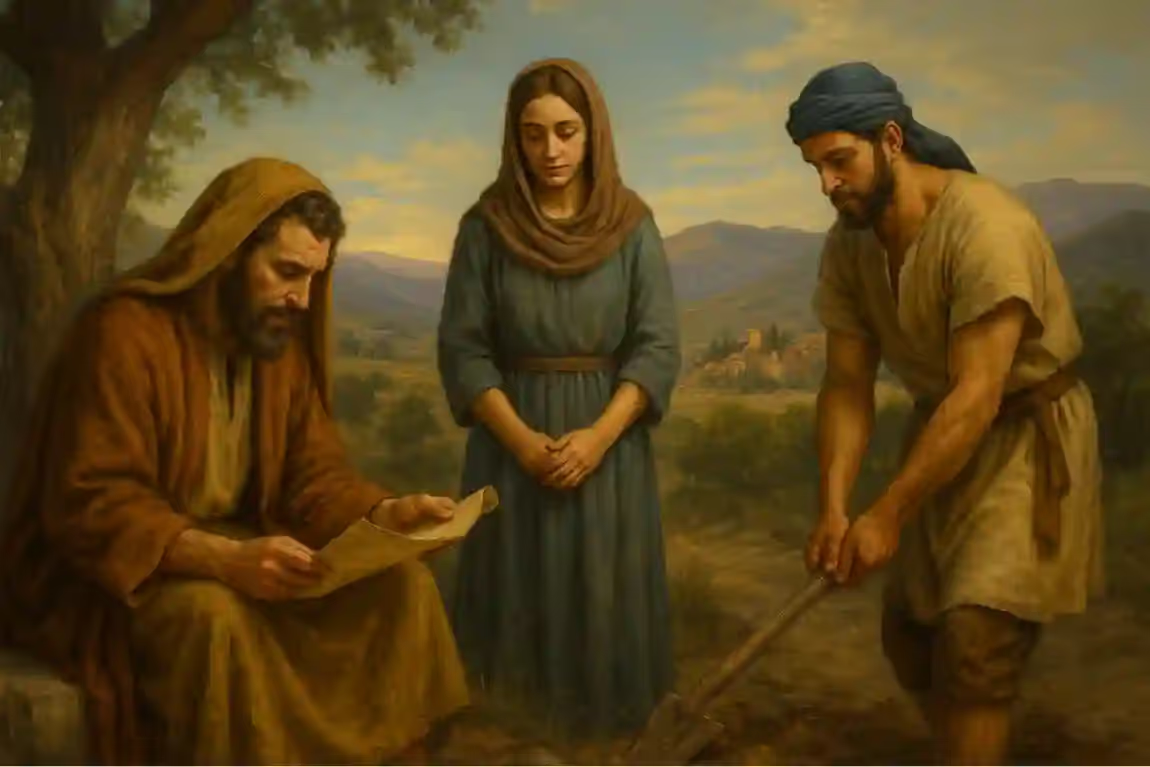
Now let me introduce you to a man whose name most Christians would not recognize despite being one of the first people in scripture explicitly described as being filled with the Spirit of God for a specific task. Bezalel appears in Exodus chapters thirty-one and thirty-five through thirty-eight, where God identifies him by name and explains that he has been filled with divine Spirit, with wisdom, with understanding, with knowledge, and with all kinds of skills to work in gold, silver, bronze, stone, wood, and every other craft necessary for constructing the tabernacle and all its furnishings according to the patterns God showed Moses on Mount Sinai. Think about the significance of God choosing to fill someone with his Spirit not for preaching, not for prophecy, not for performing miracles, but rather for artistic and technical work creating beautiful objects for worship that craftsmanship would produce through skill that divine empowerment enhanced supernaturally.
This detail matters theologically because it establishes that God values beauty, artistry, and skilled craftsmanship as activities worth empowering through his Spirit just as much as he values the more obviously spiritual tasks that religious activity encompasses typically. Bezalel was not just making functional objects that utility alone justified constructing practically. He was creating works of art that expressed truth about God’s character through their beauty, their excellence, and their adherence to divinely revealed patterns that symbolism embedded deliberately. The tabernacle and everything in it taught theological truths through visual and physical means that engaged senses and imagination in ways that verbal teaching alone could never accomplish as effectively when beauty communicates realities that propositional statements describe less powerfully.
Consider how Bezalel’s work enabled everything that happened at the tabernacle across the decades Israel spent in the wilderness and beyond. Every sacrifice offered, every prayer lifted, every encounter with God’s presence in the Holy of Holies occurred within spaces and using objects that Bezalel and his team had crafted faithfully according to divine specifications that obedience honored meticulously. His faithful artistry created the physical context where an entire nation learned to worship God properly through systems that would eventually point forward toward Christ whose sacrifice the tabernacle prefigured symbolically. Most believers today could not name the person who built the tabernacle despite its centrality to Old Testament worship, yet this obscure craftsman’s work shaped Israel’s spiritual life more profoundly than many of the famous prophets and kings whose names everyone recognizes immediately. His story teaches that God calls some people not to preach or teach but rather to create beauty, to work with excellence, and to use artistic gifts for purposes that transcend mere decoration by communicating truths that aesthetics conveys uniquely when craftsmanship serves worship that glory expresses visibly.
Let me tell you about a woman whose story occupies only a few verses in Second Samuel chapter twenty-one yet whose desperate act of maternal devotion moved King David to perform a merciful deed he had been neglecting for years despite knowing it needed addressing eventually. Rizpah was a concubine of King Saul who bore him two sons, and after both Saul and his legitimate heir Jonathan had died, David became king over a united Israel finally. However, a three-year famine afflicted the land during David’s reign, and when he inquired of the Lord about its cause, God revealed that blood guilt remained on Saul’s house because Saul had killed Gibeonites in violation of a treaty Israel had made with them centuries earlier during Joshua’s time. To atone for this bloodguilt and end the famine, the Gibeonites requested that seven of Saul’s descendants be handed over for execution, and David complied by giving them Rizpah’s two sons along with five grandsons of Saul through his daughter Merab.
Think about the horror of this situation from Rizpah’s perspective, where her sons were executed for crimes their father had committed, where their bodies were left exposed on a hill as additional humiliation, and where custom and law would have required leaving them unburied as part of the punishment that disgrace intended communicating publicly. However, Rizpah refused to accept this final indignity for her sons despite having no power to change the political and religious circumstances that had led to their deaths. She took sackcloth and spread it on a rock, then stayed there guarding her sons’ bodies day and night from the beginning of the barley harvest until the rains came months later, fighting off birds during the day and wild animals at night to prevent their remains from being devoured and scattered as would have happened naturally without her persistent vigil.
When David heard about Rizpah’s months-long vigil honoring her sons despite their disgrace, something stirred in his heart that moved him to action he had been neglecting shamefully. He realized that he had never properly buried Saul and Jonathan whose bones had been hanging in a public square since the Philistines had killed them in battle years earlier. David’s conscience was pricked by this obscure woman’s devotion to her sons, leading him to retrieve Saul and Jonathan’s remains and give them honorable burial in their family tomb, also gathering the bodies of Rizpah’s sons and the other executed descendants for proper burial rather than leaving them exposed as had been done initially. One mother’s refusal to abandon her children even in death moved the most powerful king in Israel to remember mercy and honor that grief deserved receiving despite political circumstances that expedience had justified ignoring previously. Rizpah’s story demonstrates how simple human devotion and refusal to accept injustice, even when you lack power to change systems, can move the hearts of those who do possess power when witness to faithful love convicts conscience that comfort had silenced temporarily.
Most of God’s work throughout history has happened not through celebrities whose names everybody knows but rather through faithful people in ordinary circumstances who simply obeyed what was right in front of them without any awareness that their small acts would ripple across centuries to shape redemption’s story profoundly.
Now let me introduce you to a man mentioned only briefly in Second Timothy yet whose loyal friendship during Paul’s final imprisonment demonstrates the kind of faithful devotion that costs something personally while receiving no public recognition for sacrifices that love motivates quietly. Paul mentions Onesiphorus twice in his final letter to Timothy, writing first about how this man often refreshed Paul and was not ashamed of Paul’s chains, then specifically noting that Onesiphorus searched hard for Paul in Rome until he found him when others had abandoned the apostle during his dangerous final imprisonment that would end in execution shortly. Think about what this simple statement reveals when you consider the context of Paul’s situation during his second Roman imprisonment, which differed dramatically from his first imprisonment described at the end of Acts where he had relative freedom, could receive visitors easily, and continued teaching anyone who came to him without significant interference.
By the time of his second imprisonment, probably during Nero’s persecution of Christians following the great fire of Rome in sixty-four AD, Paul was being held under much harsher conditions where association with him posed genuine danger to anyone who sought him out deliberately. Paul mentions explicitly in this same letter that everyone in the province of Asia had deserted him and that at his first defense no one came to his support, but that all had abandoned him when standing with him would have required courage that fear prevented demonstrating publicly. Into this situation of abandonment and danger came Onesiphorus, who did not wait for Paul to send for him or for circumstances to become safer before visiting. Instead, he actively searched throughout Rome until he located where Paul was being held, then visited him repeatedly to provide encouragement and practical help that isolation had denied cruelly.
The fact that Paul specifically mentions Onesiphorus was not ashamed of his chains suggests that shame was the primary emotion that kept others away when being associated with a condemned criminal might bring suspicion and persecution onto anyone who showed loyalty publicly. Onesiphorus counted the cost and decided that friendship with Paul mattered more than personal safety, that encouragement to a faithful servant of Christ in his final days outweighed the risks that devotion incurred unavoidably. Paul asks God to show mercy to Onesiphorus’s household and prays that the Lord will grant him to find mercy from the Lord on that day, suggesting that Onesiphorus himself may have died by the time Paul wrote this letter, possibly as a martyr whose loyalty to Paul had brought the very consequences that others had feared experiencing personally. This obscure man’s faithful friendship during Paul’s darkest hour demonstrates how showing up for people when it is difficult or dangerous matters enormously even though no one will remember your name or tell your story centuries later when heroism typically means something more dramatic than simply being a loyal friend who refuses to abandon someone in need.
Let me tell you about a woman whose story appears in Acts chapter nine, where her death prompted such grief in her community that they sent for Peter urgently even though he was in a different town and even though they had no guarantee he could or would do anything to help their situation. Tabitha, also called Dorcas, lived in Joppa and is described simply as a disciple who was always doing good and helping the poor, with specific mention of her making robes and other clothing for people in need. When she became sick and died, the believers in Joppa washed her body and laid it in an upstairs room, then sent two men to nearby Lydda where Peter was staying to urge him to come quickly without explaining why they needed him so urgently.
Think about what happened when Peter arrived and was taken to the room where Tabitha’s body lay. All the widows stood around him crying and showing him the robes and other clothing that Tabitha had made while she was still with them. This detail reveals something profound about the impact this seamstress had created through her simple, practical ministry of making clothes for people who could not afford them or who lacked the skills to make their own. She was not a preacher, not a prophet, not a church leader in any formal sense that titles would indicate officially. She was simply someone who used her skill with needle and thread to meet practical needs around her, who noticed that widows lacked adequate clothing, and who spent her time creating garments that love expressed tangibly through fabric and stitches that warmth provided practically.
The fact that her death moved the community to send for Peter and that the widows’ grief was so deep they surrounded her body showing her handiwork demonstrates how profoundly her quiet service had impacted people whom society often overlooked or marginalized systematically. Peter prayed, and God raised Tabitha from the dead in a miracle that brought many people to believe in the Lord when news of it spread throughout Joppa. However, the miracle itself should not overshadow the deeper lesson about what made Tabitha’s life significant before her death and resurrection occurred surprisingly. She had built a legacy through thousands of small acts of kindness, through garments sewn late at night for people she knew could not repay her, through attention paid to needs others ignored when poverty made people invisible to those focused on more impressive ministries that visibility celebrates naturally. Her story teaches that using whatever skills you possess to serve people whom society dismisses creates impact that communities remember gratefully long after flashier ministries have been forgotten completely when devotion rather than drama characterizes faithful service that love motivates consistently.
Now let me introduce you to another lesser-known hero from the New Testament whose story appears in Philippians chapter two, where Paul describes him with remarkable warmth despite this man’s obscurity in broader Christian consciousness today. Epaphroditus was sent by the church in Philippi to bring a financial gift to Paul during his imprisonment and to stay with him as their representative who would serve Paul’s needs and report back about his situation. However, while serving Paul faithfully, Epaphroditus became seriously ill to the point of death, which Paul describes as having happened because Epaphroditus risked his life to complete the work they had sent him to do when circumstances made service dangerous to his health and wellbeing.
Think about how Paul describes this man using a series of titles that reveal deep affection and high regard despite Epaphroditus never appearing anywhere else in scripture and despite his role being simply to deliver money and to serve as companion for a while. Paul calls him his brother, coworker, and fellow soldier, then describes him as the Philippians’ messenger and minister to Paul’s needs. These descriptions indicate that Epaphroditus was not just performing a task mechanically but rather was someone who had become dear to Paul through sacrificial service that love motivated authentically. The fact that Paul specifically mentions Epaphroditus was distressed because the Philippians had heard he was ill reveals someone with a servant’s heart who worried more about others being concerned for him than about his own suffering that illness produced painfully.
Paul instructs the Philippians to welcome Epaphroditus with great joy and to honor people like him, explaining that Epaphroditus almost died for the work of Christ by risking his life to make up for the help the Philippians themselves could not give Paul personally due to distance. This commendation matters because it shows how highly Paul valued faithful service even in supporting roles that visibility never acknowledged adequately compared to the more public ministries that attention celebrates naturally. Epaphroditus was not planting churches, not performing miracles, not preaching to thousands. He was simply serving Paul faithfully during imprisonment by bringing encouragement, handling practical needs, and being present as representative of a community that could not be there physically themselves. His nearly fatal illness suggests he pushed himself beyond what was safe because commitment to his mission outweighed concern for personal wellbeing when duty demanded sacrifice that health required risking. His obscure story teaches that faithful service in unglamorous roles matters deeply to God and should be honored by communities who benefit from such service even though these servants will never be famous or remembered by history that celebrates more dramatic contributions prominently.

Finally, let me introduce you to a man whose story appears in Jeremiah chapters thirty-eight and thirty-nine, where his compassionate intervention saved the prophet Jeremiah from death by starvation when powerful officials had thrown him into a muddy cistern for proclaiming messages they did not want to hear from God repeatedly. Ebed-Melech was a Cushite, meaning he was Ethiopian by ethnicity, working as an official in the royal palace of King Zedekiah during the final years before Babylon destroyed Jerusalem in five-eighty-six BC. When he heard that Jeremiah had been thrown into a cistern where he was sinking into the mud and would die if left there, Ebed-Melech immediately went to the king and spoke up courageously on behalf of the prophet despite the risks involved in contradicting powerful officials who had orchestrated Jeremiah’s imprisonment deliberately.
Think about the courage required for a foreigner working in a palace position to challenge the decisions of native officials regarding a controversial prophet most people in Jerusalem viewed as a traitor because he kept predicting Babylon would conquer them. Ebed-Melech could easily have stayed silent, reasoning that Jeremiah’s fate was not his concern and that speaking up might endanger his own position or even his life when powerful people had already decided the prophet should die through neglect that murder would accomplish indirectly. However, Ebed-Melech recognized injustice and responded with action rather than with passive observation when compassion motivated intervention despite potential costs. The king granted him permission to rescue Jeremiah, and Ebed-Melech personally supervised the operation with remarkable thoughtfulness by taking old rags and worn-out clothes to put under Jeremiah’s arms before pulling him up with ropes, protecting the prophet from injury that rough treatment would have inflicted unnecessarily.
Later, after Jerusalem had fallen to Babylon just as Jeremiah had prophesied repeatedly, God sent Jeremiah to Ebed-Melech with a special message promising that God would rescue him on the day disaster came because he had trusted in the Lord rather than fearing humans who might have punished him for defending the prophet previously. God explicitly states that he is rewarding Ebed-Melech for his compassionate action that courage motivated when fear would have counseled silence. This Ethiopian official’s story demonstrates that God sees and remembers acts of courage and compassion even when they seem small and even when performed by people outside the covenant community whom ethnic insiders might dismiss as irrelevant to God’s purposes. Ebed-Melech saved Jeremiah’s life, which meant he preserved the prophet who would record God’s words for future generations and who would live to write messages of hope during the exile that encouragement sustained when despair threatened overwhelming survivors who needed hearing from God desperately. One foreign official’s refusal to ignore injustice preserved a prophetic voice that has shaped faith for twenty-six centuries since that intervention occurred quietly in an obscure moment nobody expected mattering beyond its immediate circumstances locally.
Let me help you see how the stories of these seven lesser-known biblical heroes should reshape how you think about your own life and calling when you feel insignificant or when you wonder whether your daily faithfulness matters at all in God’s larger purposes. First, notice how none of these people were doing anything that looked historically significant at the time they were doing it. Shiphrah and Puah were just delivering babies and protecting them from an unjust king. Bezalel was just making beautiful objects according to specifications someone else had provided. Rizpah was just staying with her sons’ bodies refusing to let animals desecrate them further. Onesiphorus was just visiting a friend in prison. Tabitha was just sewing clothes for people who needed them. Epaphroditus was just delivering a gift and staying to help someone temporarily. Ebed-Melech was just speaking up about an injustice he witnessed in passing. Yet each of these ordinary faithful actions produced consequences that rippled across centuries to shape redemptive history in ways they could never have anticipated or imagined when obedience seemed small and local rather than grand and eternal.
Think about how this pattern should change your perspective regarding the small faithful actions you perform daily that no one notices or celebrates publicly. When you speak truth to power even though you lack influence to change systems fundamentally, when you use your skills to serve others without seeking recognition or reward, when you refuse to abandon people whom society marginalizes or whom circumstances make inconvenient to support loyally, when you show up for friends in difficult seasons despite personal costs that loyalty requires bearing, when you meet practical needs for people whom prosperity overlooks casually, when you complete assignments faithfully despite dangers or difficulties that service encounters unavoidably, when you defend people who cannot defend themselves even though speaking up might bring consequences you would prefer avoiding – these ordinary acts of faithfulness matter eternally even though you will probably never see how God uses them within his larger purposes that providence orchestrates mysteriously.
The challenge involves maintaining faithful obedience without requiring immediate evidence that your actions matter significantly or produce measurable outcomes that validation would provide comfortingly. These seven heroes simply did what was right in front of them without knowing their stories would be preserved in scripture or that their choices would affect redemptive history so profoundly. They were faithful in obscurity, serving without audiences to applaud them, obeying without guarantees that anyone would remember their contributions beyond their immediate context. This is precisely the kind of faithfulness God seems to value most highly, where obedience flows from love and conviction rather than from desire for recognition that ego seeks. Your life probably will not be remembered by history thousands of years from now, but faithfulness in ordinary moments still shapes eternity in ways only God can see fully when every act of obedience produces ripples that compound across time to accomplish purposes beyond anything you could orchestrate or comprehend independently. Resources exploring faithful obscurity, like those from Ligonier on anonymous saints, can encourage you toward this kind of quiet faithfulness.
Michael Chen from our opening story spent the weeks following that youth group question researching lesser-known biblical heroes and discovering dozens of figures whose stories he had never noticed despite reading scripture for years regularly. He began teaching his students about these forgotten heroes intentionally, showing them that God’s kingdom advances primarily through ordinary people doing faithful things in unremarkable circumstances rather than through celebrities performing spectacular feats that visibility celebrates naturally. The students responded with surprising enthusiasm to these stories precisely because they felt more attainable than the narratives about Moses and David that seemed impossibly distant from their everyday teenage experiences.
One student mentioned that learning about Tabitha made her feel better about her own gifts when she had been feeling useless because she was not good at public speaking or leading worship like some of her peers who received constant affirmation for visible talents. She realized that using her skills in graphic design to create materials for church events mattered just as much as the more visible roles that attention received automatically, because faithfulness rather than visibility determines significance when God evaluates service that love motivates authentically. Another student said the story of Onesiphorus challenged him to maintain friendships with classmates who had become unpopular or who were going through difficult seasons when convenience would suggest distancing himself to protect his own social standing from association that loyalty would require accepting.
Michael realized through teaching these stories that he had also needed to hear them himself, because his own ministry had been shaped by subtle pressure to produce measurable results that success would validate visibly through numbers and growth that metrics could quantify objectively. The lesser-known heroes reminded him that faithfulness in small things matters more than spectacular achievements that audiences applaud temporarily before forgetting completely when novelty fades. He began praying differently, asking God not for bigger platforms or more visible ministry opportunities but rather for faithfulness in whatever circumstances God had placed him currently, trusting that ordinary obedience produces extraordinary impact across time when providence compounds small faithfulness into outcomes only divine orchestration could accomplish mysteriously. The forgotten heroes of scripture had taught him something the famous heroes never could, which is that obscurity does not equal insignificance and that the most important work often happens quietly through people whose names nobody will remember when history typically celebrates those whose visibility suggested importance that posthumous fame validates selectively.
NOVEMBER 25, 2025
NOVEMBER 24, 2025
NOVEMBER 24, 2025
NOVEMBER 24, 2025
NOVEMBER 24, 2025