

How to Study the Bible Effectively: A Pentecostal Approach
NOVEMBER 25, 2025

Jennifer Park had been teaching Sunday school for elementary students for three years when she encountered a parable that stopped her lesson planning completely, forcing her to confront how little she actually understood about some of Jesus' most famous stories despite having heard them dozens of times throughout her life in church contexts. She was preparing to teach the parable of the ten virgins, those bridesmaids waiting for the bridegroom with their lamps, where five brought extra oil and five did not, and where the unprepared ones missed the wedding feast entirely when they left to buy more oil at the crucial moment. Jennifer had always assumed this parable was straightforward, a simple lesson about being prepared for Christ's return by maintaining your faith consistently rather than letting spiritual disciplines lapse during waiting periods. However, as she read the passage more carefully this time while thinking about how to explain it to children who would ask probing questions that adults politely avoided, she realized the story contained deeply troubling elements that her previous understanding had smoothed over unconsciously. Why did the wise virgins refuse to share their oil with the foolish ones when they asked desperately for help? This seemed to contradict everything else Jesus taught about generosity, compassion, and helping those in need sacrificially. Why did the bridegroom reject the late-arriving virgins so harshly, telling them he did not know them when they had clearly been invited originally and had only stepped away briefly to rectify their mistake? The parable ended with Jesus simply saying "Therefore keep watch, because you do not know the day or the hour," offering no explanation of what the oil represented, why sharing was impossible, or what lesson the harsh exclusion was meant to teach beyond general vigilance. Jennifer realized that Jesus had told this parable and then moved on without unpacking its meaning the way he had explained the parable of the sower or the parable of the weeds among the wheat when his disciples asked privately for clarification. She was left wrestling with a story that seemed both critically important and frustratingly opaque, where multiple interpretations competed without any clear indication which one Jesus actually intended when he chose these specific details deliberately.
This article explores the parables that Jesus told without providing explicit interpretation, examining why he might have left certain stories open to wrestling and reflection rather than spelling out their meanings directly. Let me help you see how these unexplained parables actually invite you into deeper engagement with truth than straightforward explanations would produce, show you fresh ways of interpreting stories you may have heard so many times that familiarity has dulled their edge, and guide you toward wrestling with these texts the way Jesus apparently intended rather than settling for surface readings that miss the provocative depths these deceptively simple stories contain deliberately.
Before I can help you interpret specific unexplained parables, I need to help you grasp why Jesus used this teaching method so extensively when straightforward instruction would have communicated his points more efficiently and with less risk of misunderstanding. Think about how most teachers approach instruction, where they start with general principles and then perhaps add illustrations to make abstract concepts more concrete and memorable. However, Jesus often worked in reverse, telling a story first and sometimes never explicitly stating the principle the story was meant to illustrate. This approach seems deliberately inefficient unless you consider what Jesus was trying to accomplish beyond merely transferring information from his mind to his listeners' minds directly. As GotQuestions explains regarding why Jesus taught in parables, parables were a common form of teaching in Judaism, and Jesus used them not merely as sermon illustrations but as a distinctive method that revealed truth to those with receptive hearts while concealing it from those who had hardened themselves against his message.
Let me use a comparison that will help you see the pedagogical wisdom in this mysterious teaching method. Imagine a teacher who wants students to truly understand gravity rather than just memorizing that objects fall at a certain rate. The teacher could simply state the law of gravity and have students repeat it back accurately. However, this would produce knowledge without genuine comprehension, where students could recite facts without deeply grasping the principle or being able to apply it to novel situations that formulas alone would not address adequately. Alternatively, the teacher could present various scenarios and experiments, letting students observe patterns, form hypotheses, and discover the principle themselves through guided exploration that engagement requires actively. This second approach takes longer and creates more initial confusion, but it produces understanding that goes deeper than mere memorization because students have wrestled with the concept themselves rather than passively receiving information that retention alone does not guarantee applying wisely.
Jesus used parables to create exactly this kind of deeper engagement with truth, where listeners had to wrestle with stories that did not yield their meanings easily or obviously. When Jesus was asked directly why he spoke in parables, he gave a somewhat cryptic answer from Isaiah about people seeing but not perceiving, hearing but not understanding. This was not about deliberately obscuring truth from sincere seekers, but rather about recognizing that spiritual truth requires a particular kind of heart posture to receive genuinely. Parables function as tests that reveal what kind of soil your heart represents, whether you will dig deeper into challenging stories or whether you will dismiss them as quaint tales that surface reading exhausts completely. The Desiring God article on why Jesus spoke in parables explains that when Jesus spoke in parables, he was doing far more than harnessing the power of story—he was exposing the very hearts of his hearers. The unexplained parables particularly serve this function, because they refuse to let you remain passive consumers of religious information and instead demand that you become active participants in discovering meaning that wrestling alone produces authentically.
Let me identify the key parables where Jesus told the story and then moved on without providing the kind of detailed interpretation he gave for some other parables when disciples asked for clarification directly. First, the parable of the ten virgins waiting for the bridegroom with their lamps appears in Matthew 25, ending only with the exhortation to stay alert without explaining what the oil represents or why sharing proved impossible when need arose urgently. Second, the parable of the talents, where servants receive different amounts to invest and face judgment based on returns they produced, raises questions about whether this represents actual abilities or opportunities, and whether the harsh treatment of the cautious servant reflects literal expectation or serves as hyperbole that warning employs dramatically. Third, the parable of the persistent widow who keeps bothering an unjust judge until he grants her request appears in Luke 18, where Jesus makes a brief comment about God hearing prayers but does not fully explain how the unjust judge relates to the righteous God metaphorically. Fourth, the parable of the rich fool who builds bigger barns to store his abundance only to die that very night receives no interpretation beyond Jesus' warning about greed, leaving questions about whether accumulating wealth itself is wrong or whether the issue was exclusively the man's attitude and priorities that possessions dominated completely. Fifth, the parable of the friend at midnight who keeps knocking until his neighbor gives him bread out of sheer annoyance functions similarly to the persistent widow story, creating interpretive challenges about whether God responds to persistent prayer reluctantly like the annoyed neighbor or whether the comparison works differently than surface reading suggests initially.
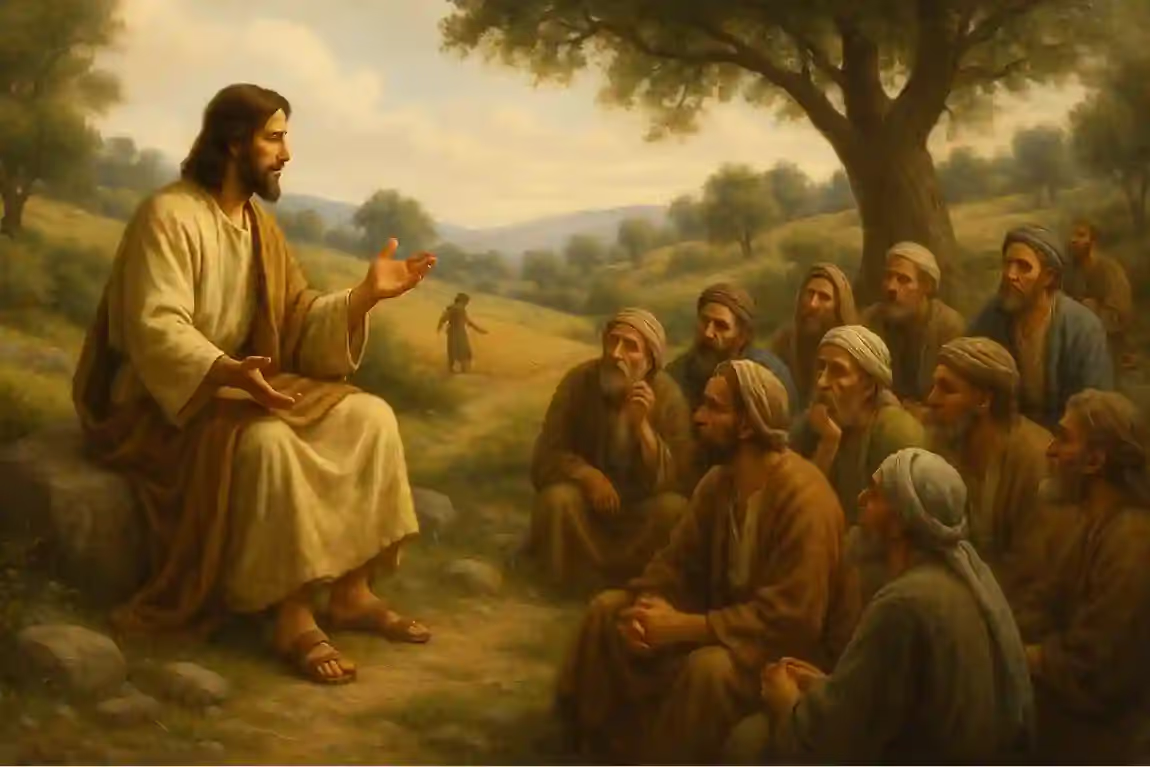
Now let me walk you through a deeper interpretation of the ten virgins parable that addresses the troubling questions about why the wise virgins refused to share their oil and what this story reveals about spiritual readiness that external religious activity cannot substitute for when genuine transformation remains absent internally. The traditional interpretation focuses primarily on the surface lesson about being prepared for Christ's return by maintaining spiritual disciplines consistently. However, this reading does not adequately address why sharing oil was impossible when Jesus taught so extensively about generosity and meeting others' needs sacrificially throughout his ministry otherwise. As the Wikipedia article on this parable notes, various interpretations have emerged throughout church history, with St. Seraphim of Sarov suggesting that what the foolish virgins lacked was the grace of the Holy Spirit, noting that these virgins practiced the virtues but in their spiritual ignorance supposed that the Christian life consisted merely in doing good works.
Think about what oil might represent that makes it inherently non-transferable from one person to another regardless of how generous you want to be. The oil likely symbolizes the internal spiritual reality of genuine relationship with God that external religious participation cannot substitute for adequately. You can share knowledge about God, you can invite someone to church, you can pray for others, you can model faithfulness through your example, but you cannot transfer your actual relationship with God to someone else like handing them a physical object they could possess independently. Each person must cultivate their own walk with God through personal prayer, through wrestling with scripture themselves, through their own repentance and faith that no one else can perform on their behalf regardless of how much they might want to help. The Church of Jesus Christ's interpretation of this parable explains that the oil represents our faith and testimony, our purity and dedication, our good works, and our keeping of covenants—all of the ways in which we have taken the Holy Spirit for our guide, and that the wise virgins could not share their oil with the foolish virgins because the oil of spiritual preparedness cannot be shared.
This interpretation explains why the wise virgins were not being selfish when they refused to share, because sharing was literally impossible given what the oil represented metaphorically. If they had given away half their oil, then all ten virgins would have ended up unprepared instead of just five, which would not have served anyone's interests ultimately. The parable warns against assuming that proximity to genuine believers automatically makes you ready for Christ's return, or that participating in external religious activities substitutes for the internal spiritual reality that authentic faith produces necessarily. You can attend every church service, serve in multiple ministries, and associate closely with mature Christians, yet still lack the personal relationship with God that readiness requires possessing individually. The bridegroom's harsh words "I don't know you" reinforce this point, because mere external association without genuine relationship does not constitute knowing someone in the intimate sense that covenant relationship creates mutually. This parable challenges comfortable assumptions about religious participation guaranteeing salvation when heart transformation remains the essential element that external behaviors sometimes mask rather than reflect accurately.
Let me help you see what the varying amounts of talents might represent beyond the common interpretation that they symbolize natural abilities or spiritual gifts that God distributes differently among believers. While that interpretation contains truth, it does not fully account for why the master gave different amounts in the first place, or why the servant with one talent gets condemned so harshly for simply preserving what was entrusted to him cautiously rather than risking it through investment that loss might have produced disastrously. The Theology of Work commentary on this parable notes that the meaning extends far beyond financial investments, explaining that God has given each person a wide variety of gifts, and he expects us to employ those gifts in his service. Think about how the parable specifically mentions that the master distributed the talents "each according to his ability," which suggests the amounts were calibrated to match each servant's capacity rather than being arbitrary or designed to create unfair situations that resentment would justify naturally. This detail indicates that God knows exactly what each person can handle and never gives you more responsibility than your current capacity can manage appropriately when faithfulness requires abilities matching assignments realistically.
Now let me address the most troubling aspect of this parable, where the servant who carefully preserved his one talent gets called wicked and lazy, has his talent taken away, and ends up cast into outer darkness despite having done nothing actively wrong beyond being too cautious with what he was entrusted temporarily. The key to interpreting this harsh judgment lies in the servant's own words when he explains why he buried the talent instead of investing it productively. He says he was afraid because he knew the master was a hard man who harvests where he has not sown and gathers where he has not scattered seed. This statement reveals that the servant fundamentally misunderstood the master's character, viewing him as harsh and unreasonable rather than as generous and trustworthy despite the master's actions suggesting the opposite when he entrusted valuable resources to his servants freely. As Wikipedia's analysis of the parable explains, from a psychological point of view, the failure is the immediate result of the failure of feeling God's love—the first two servants are able to see God in a positive perception, as understanding, generous, and kind, while the third servant sees God as harsh, demanding, and critical.
The servant's fear was not reverent awe that appropriate respect produces, but rather paralyzing anxiety rooted in distorted view of who the master was essentially. This distortion prevented him from taking any risks or attempting any growth because he approached the relationship from defensive posture focused on avoiding punishment rather than from confident trust that freedom enables acting courageously. The parable warns that wrong views of God's character produce spiritual paralysis where you either do nothing or only perform minimal religious duties that obligation requires grudgingly rather than joyfully embracing opportunities that trust makes possible venturing boldly. The harshness of judgment reflects not the master's actual character but rather the inevitable consequence of remaining in wrong relationship where fear dominates instead of love that perfect relationship would cast out completely.
Finally, let me help you wrestle with the deeply uncomfortable statement that concludes this parable, where the master declares that to those who have, more will be given, while from those who have nothing, even what they have will be taken away. This principle seems to violate every instinct about fairness and to contradict Jesus' teachings about caring for the poor and lifting up the lowly consistently throughout the gospels. However, the principle describes spiritual reality rather than prescribing economic policy that injustice would promote wrongly. Think about how learning compounds over time, where someone who has mastered fundamentals can build on that foundation progressively, while someone who refuses to engage with basics never advances beyond surface level regardless of opportunities that availability provides generously. Similarly, someone who faithfully uses whatever spiritual opportunities and resources they currently possess will find that God entrusts them with more as their capacity grows through exercise that development requires experiencing practically. However, someone who does nothing with what they have been given will eventually lose even that through atrophy that disuse produces inevitably when muscles that exercise never strengthens progressively deteriorate from lack of activation entirely. This is not favoritism toward the already advantaged but rather the natural consequence of stewardship where faithfulness in small things leads to greater responsibilities while unfaithfulness even in limited spheres results in loss of opportunity that abdication forfeits voluntarily.
The parables Jesus left unexplained invite you into the kind of wrestling with truth that produces deeper transformation than straightforward explanations could accomplish, because you must engage your whole heart and mind rather than simply agreeing intellectually with conclusions that someone else reached for you passively.
Let me walk you through interpreting this parable that Jesus introduces explicitly as teaching about the need to pray persistently without giving up, yet which creates significant interpretive challenges when you consider how the comparison between God and an unjust judge actually functions within the story's logic. The parable presents a widow who keeps coming to a judge who neither fears God nor cares what people think, asking for justice against her adversary repeatedly until the judge finally grants her request simply to stop her from bothering him anymore with her persistent appeals. Jesus then says that if even an unjust judge will eventually give justice through sheer weariness, how much more will God give justice to his chosen ones who cry out to him day and night. The GotQuestions article on the persistent widow parable explains that the parable demonstrates that effective prayer requires tenacity and faithfulness, and that a genuine disciple must learn that prayer never gives up and is based on absolute trust and faith in God.
Think about how this parable works through contrast rather than through direct comparison, where the point is not that God resembles the unjust judge but rather that God differs from him so dramatically that you can trust him even more certainly than the widow could trust the judge who eventually yielded to her persistence reluctantly. The parable employs what scholars call "how much more" reasoning, where if something is true in a lesser case, it must be even more true in a greater case that surpasses the first scenario significantly. If a corrupt judge who does not care about justice will eventually respond to persistent requests simply to avoid being annoyed, how much more will a perfectly just and loving God respond to the persistent prayers of his children whom he cares about deeply and whom he desires to help rather than to ignore or dismiss carelessly. As the Ligonier Ministries devotional on this parable notes, the unjust judge does not represent anything beyond himself—he is not a symbol for God, or the devil, or anyone else—instead, he is a character that Jesus invents in order to develop a comparison that stresses the Lord's willingness to hear and respond to the prayers of His people.
However, the parable also acknowledges implicitly what your experience confirms regularly, which is that God often does not answer prayers immediately or in the timing you expect when delays suggest indifference that disappointment interprets as rejection wrongly. The widow had to keep coming back repeatedly before receiving justice, which reflects the reality that prayer often requires persistence across extended periods when immediate answers would seem more consistent with God's love and power that theology affirms confidently. The parable does not fully explain this tension but rather validates that persistence in prayer is appropriate and necessary rather than indicating lack of faith that single petition should have demonstrated sufficiently. The challenge involves maintaining persistence without slipping into the wrong conclusion that God is like the unjust judge who must be worn down through nagging when actually he cares deeply but operates according to timing and purposes that wisdom employs beyond your current comprehension fully.
Let me help you understand what makes the rich man in this parable foolish beyond the obvious fact that he died before enjoying the abundance he had accumulated carefully. The story presents a farmer whose land produces such an abundant harvest that his existing storage facilities cannot contain it all, leading him to decide to tear down his current barns and build larger ones where he can store everything comfortably. Once this expansion is complete, he plans to tell himself that he has plenty stored up for many years to come, enabling him to relax, eat, drink, and be merry without worrying about the future that provision has apparently secured adequately. However, God calls him a fool and tells him that this very night his life will be demanded from him, leaving him to wonder who will get what he has accumulated when death claims him unexpectedly.
The foolishness lies not in having wealth or in planning wisely for the future, because scripture elsewhere commends both prosperity earned through honest work and prudent preparation for needs that tomorrow will bring inevitably. Rather, the foolishness consists in multiple layers of wrongheaded thinking that prosperity enabled developing when abundance removed constraints that limitation had imposed previously. First, notice how the man talks exclusively to himself throughout his internal monologue, never mentioning God, never considering others who might benefit from his abundance, and never thinking beyond his own comfort and security that self-focus prioritizes exclusively. His repeated use of "I" and "my" reveals an orientation entirely centered on self rather than on God or on community that generosity would consider including naturally. Second, he assumes his life will extend indefinitely into the future, making plans that "many years" suggests when actually he has no guarantee of tomorrow regardless of how healthy he currently feels or how much provision he has accumulated carefully. Third, he equates security with material abundance, believing that sufficient possessions will enable him to relax completely when actually no amount of wealth provides genuine security against death, disease, or countless other threats that prosperity cannot prevent affecting you eventually.
Jesus concludes the parable by saying "This is how it will be with whoever stores up things for themselves but is not rich toward God," which reveals that the real issue concerns where you invest your ultimate trust and what kind of wealth you prioritize accumulating primarily. Being rich toward God involves investing in eternal realities that death cannot take from you, cultivating relationship with him that continues beyond this life, and using whatever earthly resources you possess for purposes that transcend your temporary existence here. The parable warns that prosperity creates particular spiritual danger because abundance makes it easy to feel secure, self-sufficient, and focused on enjoying comfort rather than maintaining the dependence on God that poverty or limitation forces acknowledging daily. This does not mean poverty is inherently more spiritual than wealth, but rather that wealth requires greater vigilance to avoid the deception that security comes from possessions rather than from relationship with God who gives and takes away according to purposes that sovereignty directs wisely.
Let me help you consider why Jesus chose to explain some parables explicitly to his disciples while leaving others open to wrestling and interpretation that engagement requires pursuing actively. The parables Jesus explained, like the sower and the weeds among wheat, contain allegories where specific elements correspond systematically to particular spiritual realities that decoding makes comprehensible clearly. However, the unexplained parables often work differently, functioning more like metaphors that capture truth holistically rather than through point-by-point correspondence that allegory employs precisely. These stories resist being reduced to single clear meanings that formulas would capture completely, instead revealing different facets of truth depending on what angle you approach them from or what questions you bring to the text currently. The Gospel Coalition's analysis of the purpose of parables explores how parables were designed to both reveal and conceal truths about the Kingdom of Heaven, making them accessible to those receptive to Jesus' message while simultaneously hiding these truths from the unreceptive.
Think about how the best literature works, where great novels or poems continue yielding new insights each time you read them because their truth operates at multiple levels simultaneously rather than expressing single propositions that one reading exhausts thoroughly. Jesus left certain parables unexplained because the process of wrestling with them serves formational purposes that having answers simply handed to you would bypass entirely. When you must think deeply about what the oil in the lamps represents, or why the judge's character matters for understanding prayer, or what makes someone foolish beyond just dying unexpectedly, you engage with the text actively rather than passively receiving information that memory stores without transformation occurring necessarily. This wrestling develops spiritual muscles of discernment, interpretation, and application that listening to explanations never strengthens equivalently when activity rather than passivity produces growth that exercise alone enables developing progressively.
Additionally, leaving parables unexplained allows them to speak freshly to each generation and cultural context without being locked into interpretations that one particular time and place understood as obvious but that other contexts might miss entirely. The persistent widow story means something specific to people living under oppressive governments where justice seems impossible, while also speaking to anyone facing any situation where God seems slow to respond to desperate prayers that circumstances make urgent. The talents parable addresses both those with extensive resources and influence and those with limited spheres of impact, showing that faithfulness matters regardless of scale when stewardship rather than results determines evaluation ultimately. By not providing definitive interpretations, Jesus enabled these stories to continue speaking powerfully across vastly different circumstances that two thousand years have encompassed globally since he first told them originally in first-century Palestine specifically. As the Wikipedia overview of the parables of Jesus explains, scholars have commented that although these parables seem simple, the messages they convey are deep, and central to the teachings of Jesus.

Let me give you practical guidelines for wrestling with these mysterious stories in ways that honor the text while avoiding interpretations that eisegesis imposes rather than exegesis discovers faithfully. These principles will help you engage with parables in ways that produce genuine spiritual growth rather than either frustration at their difficulty or false confidence in interpretations that miss the point entirely:
Fifth, embrace humility about your interpretations while still taking the process seriously, recognizing that you might not have perfect clarity about everything Jesus intended when he told these stories but that wrestling with them still matters enormously for your spiritual formation regardless of whether you arrive at definitive answers quickly. Discuss these parables with other believers whose perspectives might illuminate aspects you missed through individual study alone, because the Spirit often teaches through community rather than exclusively through private interpretation that isolation would limit unnecessarily. Read trusted commentaries to see how the church has understood these parables across history, not to simply adopt traditional readings uncritically but to benefit from collective wisdom that centuries have accumulated through faithful reflection on texts that generations have wrestled with repeatedly. Resources like the Jesus Film Project's comprehensive guide to all parables can provide structured guidance for this interpretive work.
Let me help you see that part of maturity in faith involves accepting that some things will remain mysterious and unclear until you see face to face what you currently know only in part through limited perception. The unexplained parables train you to be comfortable with ambiguity and to trust God even when you do not fully understand everything he teaches or does. This comfort with mystery differs completely from intellectual laziness that avoids thinking deeply, or from relativism that claims all interpretations are equally valid regardless of whether they align with scripture and tradition or contradict them directly. Rather, this mature faith involves thinking as carefully as possible while recognizing the limitations of your current understanding and remaining open to correction when deeper study or the Spirit's illumination reveals errors in preliminary interpretations.
Think about how children often demand simple black-and-white answers to complex questions, becoming frustrated when adults try to explain nuances that maturity recognizes as essential for accuracy. As you grow spiritually, you develop capacity to hold tension between competing truths that both seem valid even when you cannot fully reconcile them logically within your limited frameworks. The unexplained parables often create exactly this kind of productive tension, where multiple interpretive threads all seem to capture something true about the story without any single reading exhausting the parable's meaning completely. You can live with this tension faithfully by allowing these stories to continue challenging and reshaping you rather than forcing premature closure that certainty provides comfortably but that reductionism achieves wrongly by eliminating complexity that truth actually requires maintaining honestly.
The unexplained parables remind you that knowing God involves relationship more than merely accumulating correct information about him systematically. Relationships necessarily include mystery because you can never fully comprehend another person completely regardless of how long you know them or how deeply you study them. God remains infinitely beyond your full comprehension, which means your theology should include significant space for mystery and for truths that you accept on faith even when understanding eludes your current grasp. The parables Jesus left unexplained train you to trust him even in the absence of complete clarity, to obey what you do understand while remaining humble about what remains obscure, and to keep seeking wisdom while accepting that some questions will not receive full answers until eternity makes all things clear finally. As the Bible Study Tools article on why Jesus taught in parables explains, you might understand a parable to contain two distinct layers—on the surface, an interesting story easily understood by listeners, and underneath, deeper meaning that you must search for diligently to discover fully.
Jennifer Park from our opening story decided to teach the parable of the ten virgins to her Sunday school class despite her uncertainty about how to answer all the questions it raised for her personally. Rather than pretending to have complete understanding, she chose to model for the children what faithful wrestling with difficult texts looks like practically. She told the story carefully, then asked the students what they thought it meant, listening to their initial interpretations that simplicity characterized naturally before complexity muddled everything unnecessarily. When the children asked why the wise virgins would not share their oil, Jennifer acknowledged honestly that this troubled her too, then guided them through thinking about what kinds of things you can share versus what each person must possess individually through their own effort and relationship that transfer cannot accomplish regardless of generosity.
The conversation became rich and surprising, with children offering insights that Jennifer had not considered despite her years of education and experience reading scripture regularly. One girl suggested that maybe the oil was like friendship, where you can introduce people to each other but you cannot make them be friends because that has to develop naturally through their own interactions that time alone produces gradually. One boy proposed that the oil might be like studying for a test, where your friend can help you study but cannot take the test for you when the exam finally arrives demanding individual performance. These childlike analogies captured something true about what Jesus was teaching regarding preparation that remains fundamentally individual even within community that support provides helpfully without substituting for personal responsibility ultimately.
Jennifer realized through this experience that the unexplained parables were not failures in Jesus' teaching method but rather invitations into deeper engagement with truth than straightforward explanations would have produced for students who remained passive recipients of information rather than active participants in discovery. She began approaching other difficult texts similarly, presenting them to her students as puzzles to wrestle with together rather than as problems she needed to solve completely before teaching commenced officially. Her own faith deepened through this process because she could no longer rely on secondhand interpretations that comfort provided easily but had to engage with scripture directly, asking questions, testing ideas, and allowing the text to challenge her assumptions rather than simply confirming what she already believed before study began. The parables Jesus never explained became her favorite stories precisely because they refused to let her remain passive, instead demanding the kind of active engagement that transformation requires experiencing authentically through wrestling that comfort never demands but that growth necessitates pursuing faithfully.
The Parables Jesus Never Explained: What They Mean for Us Today
NOVEMBER 25, 2025
NOVEMBER 24, 2025
NOVEMBER 24, 2025
NOVEMBER 24, 2025
NOVEMBER 24, 2025