

How to Study the Bible Effectively: A Pentecostal Approach
NOVEMBER 25, 2025
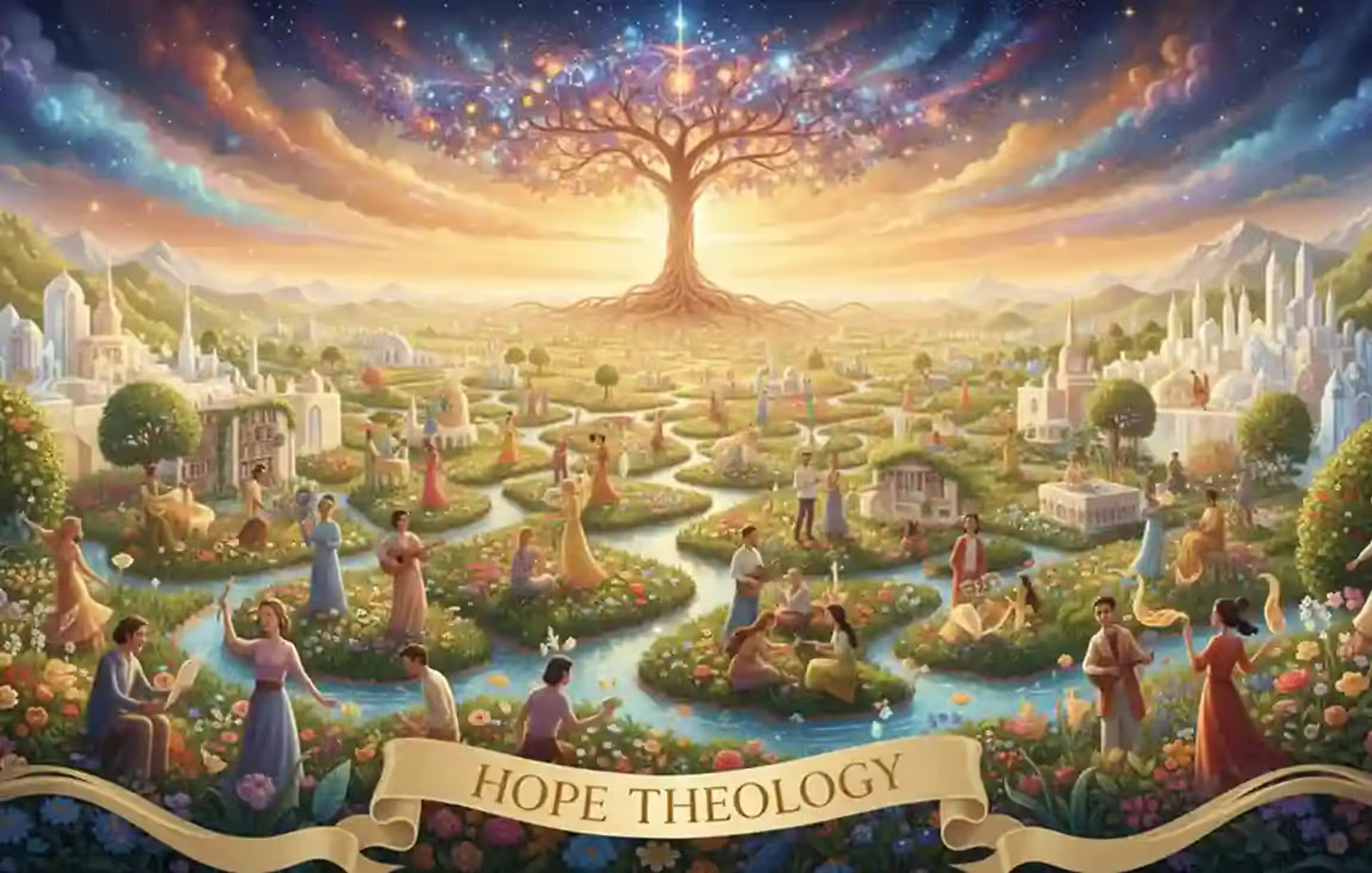
Lisa Nguyen sat in the hospital chapel after receiving news that her cancer had progressed beyond what treatment could address, forcing her to confront mortality more directly than she ever had during her forty-three years of life. Her pastor had visited earlier, offering comfort by describing heaven as a place where she would finally rest from all her struggles, where she would worship God eternally in peaceful bliss far removed from the pain and disappointment that earth had inflicted. Yet as Lisa sat alone with these reassurances, she found them strangely unsatisfying despite their intentions to console. She had always loved her work as an architect, finding deep joy in the creative process of designing spaces where people could live and flourish. She cherished her relationships with her husband, her two teenage daughters, and her close friends whose presence had enriched her life immeasurably. She delighted in physical experiences like hiking in the mountains, tasting good food, and feeling sunshine on her face during spring afternoons. The vision of heaven her pastor had offered seemed to require leaving behind everything that made her feel most alive and most herself, as though eternal life meant becoming a different kind of being whose existence consisted primarily of passive worship that bore little resemblance to the full-bodied life she had experienced on earth. Lisa found herself wondering whether this picture of heaven was actually what the Bible taught, or whether popular Christian imagination had created something that scripture itself did not quite support when examined carefully.
This article explores what the Bible actually teaches about heaven and eternal life, challenging popular misconceptions that have shaped Christian imagination for centuries despite lacking solid scriptural foundation. Let me help you see why the biblical vision of eternity is far more physical, earthy, and wonderful than the disembodied spiritual existence that many believers expect, show you how the doctrine of resurrection transforms everything about how we think about life after death, and help you grasp why this more robust hope should change how you live today when you realize that your work and relationships and even your physical body matter eternally rather than being temporary shells you will eventually discard gratefully.
Before I can show you what heaven actually is according to scripture, I need to help you recognize how profoundly the popular Christian conception of heaven has been shaped by sources other than the Bible itself, sources that include Greek philosophy, medieval art, sentimental hymns, and cartoons that have created imagery so pervasive that many believers assume it must be biblical even though scripture paints quite a different picture. Think about the common depiction of heaven as a place in the sky where disembodied souls float on clouds playing harps, where existence consists primarily of perpetual worship services, and where the ultimate goal involves escaping from physical reality into purely spiritual existence that flesh no longer constrains. This vision owes more to Plato than to Jesus, because Platonic philosophy viewed the material world as inferior to the spiritual realm and saw the body as a prison from which the soul needed liberating eventually. As theologian N.T. Wright explains in his influential work Surprised by Hope, early Christians had faith in the Resurrection, that is, not only that Jesus rose from the dead in a new body but that they would also rise from death in new bodies and into a new creation.
Let me use a comparison that will help you see how fundamentally this Greek dualism contradicts biblical theology. Imagine an author who writes a novel set in a richly detailed world, investing tremendous creative energy into describing landscapes, cities, cultures, and physical realities that make the story vivid and immersive. Then imagine the story concluding by having all the characters die and ascend to a completely different realm that has nothing to do with the world the author spent the entire book describing, as though that original setting was just a temporary stage that could be discarded once its purpose of housing characters temporarily had been fulfilled. This would represent bizarre storytelling that wasted all the detailed world-building the author had invested in creating. Yet this is essentially what much popular Christian teaching suggests about God's relationship to creation, where he crafts this magnificent physical universe in all its complexity and beauty, only to eventually discard it in favor of a purely spiritual realm that bears no connection to what he originally made.
Scripture tells a different story entirely, one where God's ultimate plan involves not abandoning creation but rather redeeming and renewing it, not rescuing souls from bodies but rather resurrecting bodies to live in renewed creation where heaven and earth unite finally. This matters enormously for how you think about your physical existence now, because if your body is just a temporary container you will eventually shed, then physical life has no eternal significance beyond being a test or trial you must endure before reaching your true spiritual home. However, if resurrection means your body matters eternally as essential part of who you are, and if new creation means this physical world will be renewed rather than replaced, then everything about how you relate to your body, to other people, to your work, and to creation itself changes when you realize these things participate in eternity rather than existing only temporarily. Resources like those from Desiring God on what heaven is like can help you explore this more biblical vision.
Let me walk you through several key passages that paint a picture of heaven quite different from popular imagination. First, Revelation chapters twenty-one and twenty-two describe not believers ascending to heaven but rather heaven descending to earth, where John sees the New Jerusalem coming down out of heaven from God, and hears a loud voice declaring that God's dwelling place is now among the people, that he will dwell with them, and that they will be his people. This imagery reverses the direction most Christians expect, because we typically think of going up to heaven when we die, whereas scripture presents heaven coming down to where we are, transforming earth into the place where God dwells with his people permanently. As the Gospel Coalition's essay on the new heaven and new earth explains, the new heavens and new earth is the culmination of the biblical story, when Christ accomplishes God's original purposes for creation and provides his people a place to dwell with God for eternity.
Second, Isaiah chapter sixty-five describes the new heavens and new earth not as ethereal spiritual realm but as a place where people build houses and dwell in them, plant vineyards and eat their fruit, where the work of their hands brings lasting joy rather than futility. The prophet declares that God's chosen ones will long enjoy the work of their hands, they will not labor in vain, and no longer will they build houses and others live in them, or plant and others eat. This vision of continuity between meaningful human activity now and in eternity stands in stark contrast to the idea that we will simply float in clouds singing forever. Third, Romans chapter eight explains that creation itself will be liberated from its bondage to decay and brought into the freedom and glory of the children of God, suggesting that physical creation participates in redemption rather than being discarded after serving its temporary purpose.
Fourth, First Corinthians chapter fifteen devotes extensive attention to resurrection bodies, emphasizing continuity with our current bodies while also describing transformation that imperishability and glory characterize finally. Paul uses the metaphor of a seed that dies and produces a plant to illustrate both continuity and transformation that resurrection involves mysteriously, declaring that what is sown perishable is raised imperishable, what is sown in dishonor is raised in glory, what is sown in weakness is raised in power, what is sown a natural body is raised a spiritual body. These passages together present a vision where physical reality matters eternally, where work and creativity continue in transformed conditions, and where the goal is not escape from materiality but rather the redemption and perfection of material existence under God's direct presence and rule.
Now let me help you grasp the profound theological significance of Revelation's vision of the New Jerusalem descending to earth rather than believers ascending to a distant heaven, because this detail transforms how we think about the relationship between heaven and earth throughout scripture. Think about how Jesus taught his disciples to pray, asking that God's will be done on earth as it is in heaven. This prayer only makes sense if heaven and earth represent two realms that will eventually converge rather than remaining permanently separate. Jesus was teaching his followers to long for and work toward the day when the conditions of heaven, where God's will operates perfectly, would characterize earth as well through transformation that redemption accomplishes finally. The 9Marks article on biblical theology of heaven describes this union of the two realms at the end of time as the old creation gives way to the new, where John sees the holy city Jerusalem coming down out of heaven from God, and where God's heavenly presence is no longer restricted to an access point on top of a mountain or to an inner room of a tabernacle.
Let me use another comparison to clarify this vision. Imagine two territories separated by war, where one operates under just and benevolent governance while the other suffers under tyranny and corruption. The ultimate goal is not for everyone in the corrupt territory to evacuate and move to the good territory, leaving the corrupt one to its fate permanently. Rather, the goal involves the good territory's ruler expanding his domain to encompass both territories, bringing the conditions of justice and flourishing to places where they currently do not exist. This is closer to what the Bible presents regarding heaven and earth, where heaven represents the realm where God's rule operates perfectly, and where the biblical hope involves that heavenly rule extending to encompass earth as well, transforming it into a place where God dwells directly with his people under conditions that his presence produces naturally. N.T. Wright captures this beautifully when he says that Jesus's resurrection is the beginning of God's new project not to snatch people away from earth to heaven but to colonize earth with the life of heaven.
This vision explains why scripture speaks of new heavens and new earth rather than just new heavens, and why Revelation describes renewed creation rather than complete replacement that starts from nothing. The Greek word translated as new in these passages can mean either new in time like something that did not exist before, or new in quality like something renewed and made better than it was. The biblical usage suggests the latter, where creation is purged of corruption and death but maintains continuity with what God originally made and called good at the beginning. As Crossway's explanation of the new heaven and new earth notes, God did not hold back when he created this world by keeping the best for heaven. This matters because it means your life on earth now participates in eternity rather than being mere prelude to your real life that begins after death. What you create, what you build, what relationships you form, what beauty you make or preserve all matter eternally because they are not destined for destruction but rather for transformation when creation itself is liberated from its groaning under sin's curse.
Let me explain why the doctrine of bodily resurrection represents one of Christianity's most distinctive and important teachings, differentiating it from other religions and philosophies that see the body as something to be escaped or transcended eventually. When the creeds affirm belief in the resurrection of the body, they are making a claim about personhood and identity that many Christians do not fully appreciate despite confessing this doctrine regularly. You are not a soul temporarily housed in a body like a ghost piloting a machine. Rather, you are a unified being where body and soul together constitute who you are essentially, which means authentic human existence always involves embodiment rather than existing as disembodied spirit that Platonic thought idealized wrongly. As C.S. Lewis wrote, and as the C.S. Lewis Institute explains, Christianity is almost the only one of the great religions which thoroughly approves of the body, which believes that matter is good, that God Himself once took on a human body, that some kind of body is going to be given to us even in Heaven and is going to be an essential part of our happiness, our beauty, and our energy.
Think about Jesus' resurrection as the prototype for what resurrection means for all believers eventually. When Jesus rose from the dead, he did not become a ghost or a spirit. He had a physical body that could be touched, that ate food, that bore the marks of crucifixion in his hands and side. Yet this body also had new properties, where it could apparently appear and disappear, could pass through locked doors, and was no longer subject to death or decay that corruption produces inevitably. Paul describes our future resurrection bodies similarly in First Corinthians fifteen, using the metaphor of a seed that dies and produces a plant to illustrate both continuity and transformation that resurrection involves mysteriously. The plant is genuinely new and different from the seed, yet it also maintains organic connection to that seed rather than being a completely unrelated entity that replacement would create independently.
This means that your body matters not just now but eternally, because you will not shed your body like an old coat but rather will receive it back transformed and glorified after death. This should change how you relate to physical existence, because your body is not an enemy to be suppressed or a temporary vehicle to be used carelessly. It is part of who you are essentially, and will be part of who you are eternally when resurrection restores bodily existence under conditions where suffering, decay, and death no longer threaten or diminish. Physical experiences of beauty, pleasure, connection, and creativity are not distractions from spiritual reality but rather foretastes of the embodied existence you will enjoy forever when creation is renewed and bodies are resurrected to live in that renewed creation permanently. As Randy Alcorn argues in his comprehensive book Heaven, this is a book about real people with real bodies enjoying close relationships with God and each other, eating, drinking, working, playing, traveling, worshiping, and discovering on a New Earth.
Heaven is not the destination where we escape earth but rather the realm of God's perfect rule that will ultimately encompass earth itself, transforming creation into the place where God dwells with his people in resurrected bodies living in renewed world that finally reflects what he always intended.
Let me address one of the most common concerns people express about heaven, which involves wondering whether eternal life will be boring if it consists only of worship services that never end across countless ages. This worry arises from misconceptions about what worship means and from failure to recognize that scripture presents a vision of renewed creation where human activities continue in transformed and perfected forms rather than being replaced by purely spiritual contemplation exclusively. When Isaiah describes people building houses and planting vineyards in the new earth, he is not speaking metaphorically but rather pointing toward real activities that creativity and work characterize naturally. When Revelation describes the kings of the earth bringing the glory and honor of the nations into the New Jerusalem, it suggests that human cultural achievements and creativity will somehow be purified and included in the renewed creation rather than being discarded as worthless.
Think about what it means that we are created in God's image, where part of bearing that image involves creativity, work, relationships, and cultivation of the world that stewardship requires exercising faithfully. These aspects of human existence do not represent concessions to our fallen state that heaven will eliminate gratefully. Rather, they reflect God's original design that sin corrupted but that redemption will restore and perfect beyond what was possible even in Eden before the fall. Work will continue in the new creation, but it will be work free from futility, where the results of labor are not threatened by decay or destruction, where creativity flows unhindered by limitation or frustration, and where collaboration happens without conflict or competition that sin introduces destructively. The Biblical Theology of Creation from the Gospel Coalition explains that the goal of God's creation and new creation has always been the same: to glorify himself by providing a place where his people can enjoy him forever, and in the new creation, this goal will be accomplished for all of eternity.
Relationships will also continue and deepen in ways we can barely imagine when perfect love casts out fear completely and when knowing and being known happens without the barriers that sin and shame erect constantly. Jesus indicated that marriage as we know it will not continue in the resurrection, but this does not mean relationships will become less intimate or meaningful. Rather, the exclusive intimacy that marriage provides in this fallen world, where we can only manage deep connection with limited numbers of people, may give way to capacity for profound connection with many people when selfishness no longer limits our ability to love or be present to others fully. Worship will certainly characterize the new creation, but worship means far more than singing songs, encompassing all of life lived in glad acknowledgment of and gratitude toward God whose presence makes everything else possible and delightful ultimately.
Before we continue exploring the ultimate hope of new creation, we need to address what theologians call the intermediate state, which refers to the condition of believers between their physical death and the future resurrection when Christ returns. This is an area where popular Christian thought often conflates two distinct realities, leading to confusion about what scripture actually teaches. When a believer dies today, they do not immediately receive their resurrection body or enter the new heavens and new earth. Rather, they enter what some call the present heaven or paradise, where they are consciously present with Christ in a blessed but incomplete state that awaits the final resurrection and renewal of all things. Paul captures this when he says to be absent from the body is to be present with the Lord in Second Corinthians chapter five, and when he tells the Philippians that his desire is to depart and be with Christ, which is far better.
Understanding this distinction helps us appreciate why the resurrection matters so much in biblical theology. If the intermediate state were our final destination, where disembodied existence with Christ constitutes complete salvation, then bodily resurrection would seem like an afterthought rather than the climax of God's redemptive plan. But scripture presents resurrection as essential to God's purposes, not optional or peripheral, because God created humans as embodied beings and intends to redeem us as embodied beings living in a renewed physical creation. The intermediate state is therefore genuinely blessed but genuinely incomplete, a period of rest and communion with Christ that awaits the fuller blessing of resurrection and new creation that Christ will accomplish when he returns. This is why Christians throughout history have confessed belief not just in life after death but in the resurrection of the body and the life everlasting, recognizing that embodied existence in renewed creation represents God's ultimate intention for his people.
Let me help you see how believing in new creation rather than escape from creation should fundamentally change your priorities and practices in the present when you recognize that your current life participates in eternity rather than being merely temporary prelude to your real existence that begins after death. This hope carries profound implications for how you approach every dimension of human experience, from the care of your physical body to the nature of your work to your engagement with issues of justice and flourishing in the world around you. The point of the resurrection, as N.T. Wright emphasizes, is that the present bodily life is not valueless just because it will die. What you do with your body in the present matters because God has a great future in store for it.
Consider these specific implications for daily life: This is the already-and-not-yet tension that characterizes Christian existence, where we live in the overlap between this present age that is passing away and the age to come that has already broken into history through Jesus' resurrection and will be consummated when he returns to complete what he started. What you do in the present, as Wright explains, by painting, preaching, singing, sewing, praying, teaching, building hospitals, digging wells, campaigning for justice, writing poems, caring for the needy, loving your neighbor as yourself, will last into God's future. These activities are not simply ways of making the present life a little less beastly, a little more bearable, until the day when we leave it behind altogether. They are part of what we may call building for God's kingdom. Resources like The Bible Project on heaven and earth can help you understand this framework more fully.
Understanding the biblical vision of new creation requires holding together two truths that might initially seem to be in tension: the genuine continuity between this world and the next, and the radical discontinuity that transformation brings. The continuity is essential because without it, the resurrection of our bodies and the renewal of creation would be meaningless. There must be some real connection between who you are now and who you will be in the resurrection, between what this creation is now and what new creation will be, or else we are not talking about renewal but replacement. Yet the discontinuity is equally essential because without it, the hope of new creation would be underwhelming rather than transformative. The new creation will not simply be this creation patched up or improved slightly but rather this creation gloriously transformed in ways we can barely imagine given our current limited perspective.
Think again about the metaphor Paul uses in First Corinthians fifteen, where he compares the relationship between our current bodies and our resurrection bodies to the relationship between a seed and the plant that grows from it. There is genuine continuity between the seed and the plant, because the plant grows from that particular seed rather than appearing from nowhere or from a different seed entirely. Yet there is also remarkable discontinuity, because the plant looks almost nothing like the seed, possessing beauty and complexity and vitality that the seed only contained in potential form. Similarly, your resurrection body will be genuinely yours, connected to who you are now in ways that make identity persist through death and resurrection. Yet your resurrection body will also be gloriously different, freed from every limitation and corruption that currently diminishes your existence, possessing capacities you can barely imagine in your present state.
This pattern of continuity-plus-transformation helps explain why we can speak meaningfully about what new creation will be like based on what we know about this creation, while also recognizing that our descriptions will always fall short of the reality that awaits. The new creation will include work and creativity and relationships and beauty and physical pleasure, because these good gifts of God in this creation will be renewed rather than discarded in the next. Yet the new creation will include these things in forms so purified and enhanced that they will feel both familiar and wonderfully strange, like coming home to a place you have always longed for but never actually visited. As the St Andrews Encyclopaedia of Theology explains, we might imagine the new creation as both taliter and aliter, the same and different, where resurrection corresponds to the sameness and heaven corresponds to the difference, holding these together while retaining the wonder of both heaven and earth.
Let me acknowledge that many questions about the new creation remain unanswered, because scripture provides framework and direction while leaving significant details unspecified that speculation cannot determine with certainty. We do not know exactly how resurrection bodies will relate to our current bodies beyond the general continuity-plus-transformation pattern Paul describes. We do not know precisely what activities will characterize the new creation beyond the broad categories of worship, work, relationships, and enjoyment of God's presence. We do not know how memories of this fallen world will function when scripture promises God will wipe away every tear, suggesting some kind of healing of painful memories without necessarily erasing them completely since they are part of who we are and who we will be in resurrection.
Think about how parents might prepare children for significant future events without being able to explain everything because the children lack the conceptual framework or experience to fully grasp what is coming. The parents can still convey genuine truth and create appropriate anticipation without providing exhaustive details that comprehension would exceed currently. Similarly, scripture provides us with enough information to hope rightly and to live accordingly without satisfying all our curiosity about exactly how things will work when creation is renewed and we are resurrected. This combination of certainty about core realities and appropriate mystery about details requires the kind of humble faith that trusts God while remaining comfortable with not knowing everything in advance. The GotQuestions resource on the new heavens and earth helpfully notes that in the new creation, sin will be totally eradicated, there shall be no more curse, and God's people will dwell with him forever in a world where righteousness dwells.
What we can be confident about is that the new creation will be better than we can currently imagine, because God's purposes always exceed our limited expectations when his generosity and creativity surpass what finite creatures can conceive independently. We can trust that resurrection will feel like coming home to your true self rather than like becoming someone unrecognizably different, because continuity matters alongside transformation when identity persists through change. We can believe that the new creation will satisfy every legitimate longing you have ever experienced while also surprising you with delights you never knew to desire, because God made you for this destiny and has been preparing you for it throughout your entire earthly existence that formation serves purposefully. As Paul writes in First Corinthians two, no eye has seen, no ear has heard, no human mind has conceived what God has prepared for those who love him, pointing toward glories beyond our current capacity to imagine while assuring us that they are gloriously real nonetheless.
One of the most practical benefits of understanding the biblical vision of new creation involves how this hope sustains believers through seasons of suffering and loss that would otherwise overwhelm with despair. When you face pain, disappointment, grief, or seemingly meaningless tragedy, the hope of new creation provides perspective that does not minimize current suffering but rather sets it in larger context where God's redemptive purposes give meaning to what might otherwise seem pointless. Romans chapter eight speaks of present sufferings that are not worth comparing with the glory that will be revealed in us, not because present sufferings are insignificant but because future glory is so magnificent that it outweighs even the most intense pain we currently experience.
This hope also provides assurance that nothing good will ultimately be lost. The relationships you cherish, the work you invest in, the beauty you create or experience, the growth you achieve through struggle and discipline, none of these disappear into nothingness when you die or when this age ends. They are seeds planted that will bear fruit in new creation, contributions to a story that continues rather than endings that negate what came before. Even suffering itself can be transformed into something meaningful when viewed through the lens of new creation hope, because the perseverance and character and hope that suffering produces according to Romans chapter five are eternal qualities you carry into resurrection rather than temporary states that death erases. The New Creation Model from Shepherds Theological Seminary emphasizes that a New Creation Model approach captures the richness and dimensions of all people groups in God's purposes, addressing not just individual salvation but the whole scope of God's redemptive work.
This does not mean that suffering is good or that we should not lament the genuine losses we experience in this fallen world. The biblical vision includes honest acknowledgment that creation groans and that we groan inwardly as we wait eagerly for our adoption to sonship, the redemption of our bodies. Grief is appropriate response to death and loss and pain, and the hope of new creation does not require pretending that suffering does not hurt or that loss is not real. What this hope provides is assurance that grief is not the final word, that loss will be reversed, that the tears God wipes away presuppose genuine weeping that occurred before the wiping. We sorrow, but not as those who have no hope, holding together the reality of present pain and the certainty of future restoration in the tension that characterizes faithful Christian existence between the times.
Lisa Nguyen from our opening story began studying what the Bible actually teaches about heaven during the months following her terminal diagnosis, reading theology she had never encountered in her years of churchgoing despite its solid biblical foundation. She discovered that the hope scripture offers is far more embodied, earthy, and creative than the ethereal spiritual existence she had been taught to expect. Rather than dreading the loss of everything that made her feel alive and human, she began anticipating resurrection as the perfection and fulfillment of those very things she loved most deeply about existence.
She realized that her joy in designing beautiful spaces where people could flourish was not a distraction from spiritual reality but rather a participation in God's own creative nature that she bore as image-bearer. That creativity would not be discarded in eternity but rather would be freed to operate without the frustrations and limitations that sin imposed temporarily. Her love for her family was not something she would leave behind but rather something that would be transformed and deepened when perfect love became possible between people who no longer struggled against selfishness and fear. Her delight in physical experiences like tasting and touching and seeing beauty was not lower pleasure to be transcended but rather foretaste of resurrection existence where senses would be sharpened rather than dulled, where physical reality would be more vivid rather than less so than what she currently experienced.
This hope transformed how Lisa faced her remaining months, where instead of grimly resigning herself to losing everything she cherished, she could look forward to receiving it back transformed and perfected beyond what was possible in a world still groaning under sin's curse. She spent her final weeks creating beauty through small designs, investing in relationships that would continue eternally, and savoring physical pleasures that previewed the embodied existence she would enjoy in resurrection when God's promise to make all things new would be fulfilled completely. Her funeral was not a mournful occasion where people pretended she had gone to a better place that bore no connection to the life she had lived here. Rather, it was a celebration of resurrection hope, where believers affirmed that Lisa would rise bodily to live in new creation where heaven and earth unite finally, where the work she loved, the relationships she cherished, and the physical existence she delighted in would all continue in forms perfected beyond anything death could destroy or time could diminish when God completes the redemption he began in Christ and will finish when he makes his dwelling with humanity on renewed earth eternally.
The biblical vision of heaven and eternal life stands in stark contrast to the disembodied, ethereal existence that popular Christian imagination has unfortunately promoted for centuries. Scripture presents a hope that is far more robust, far more physical, and far more connected to the life we currently live than many believers have been taught to expect. When you understand that God's plan involves not abandoning creation but renewing it, not rescuing souls from bodies but resurrecting bodies to live in renewed creation, everything changes about how you view your current existence and your future hope. Your body matters. Your work matters. Your relationships matter. Your engagement with creation and culture matters. These are not temporary distractions from your real spiritual life but rather dimensions of existence that will be perfected and continued in the new heavens and new earth that God has promised.
As you reflect on what you have learned, consider how this hope might transform your daily life. How might you live differently if you truly believed that your body is destined for resurrection rather than disposal? How might you approach your work differently if you understood it as participation in God's creative purposes that will somehow be included in new creation? How might you invest in relationships differently if you recognized that the love you cultivate now will continue and deepen in eternity? How might you engage with issues of justice and human flourishing differently if you saw them as anticipations of the conditions God will establish fully when he makes all things new? The hope of new creation is not meant to make us so heavenly minded that we are of no earthly good. Rather, it is meant to give us confidence and motivation to invest fully in this life precisely because this life matters eternally when viewed through the lens of resurrection and renewal that God has promised in Christ.
The next time you hear someone describe heaven as a place of clouds and harps where disembodied spirits float in endless worship services, you can gently point them toward the biblical vision that is so much richer and more wonderful. The next time you feel the weight of mortality pressing upon you as you face illness or age or the death of someone you love, you can find comfort not in vague reassurances about going to a better place but in the specific promise that you will be resurrected bodily to live in a renewed creation where every tear is wiped away and death is swallowed up in victory. And the next time you are tempted to see your physical existence, your work, your relationships, or your engagement with this world as spiritually unimportant, you can remember that God created all these good things, that he will redeem and perfect them rather than discarding them, and that your faithfulness in these areas now has eternal significance that extends far beyond what you can currently see or imagine. This is the hope that scripture offers, the hope that sustained believers through centuries of persecution and suffering, the hope that can sustain you through whatever challenges you face, the hope that will not disappoint because it is grounded in the resurrection of Jesus Christ, the firstfruits of those who have fallen asleep, the guarantee that God will complete the work he has begun and make all things new.
NOVEMBER 25, 2025
NOVEMBER 24, 2025
NOVEMBER 24, 2025
NOVEMBER 24, 2025
NOVEMBER 24, 2025