

Why Christian Community Matters More Than Ever
NOVEMBER 25, 2025

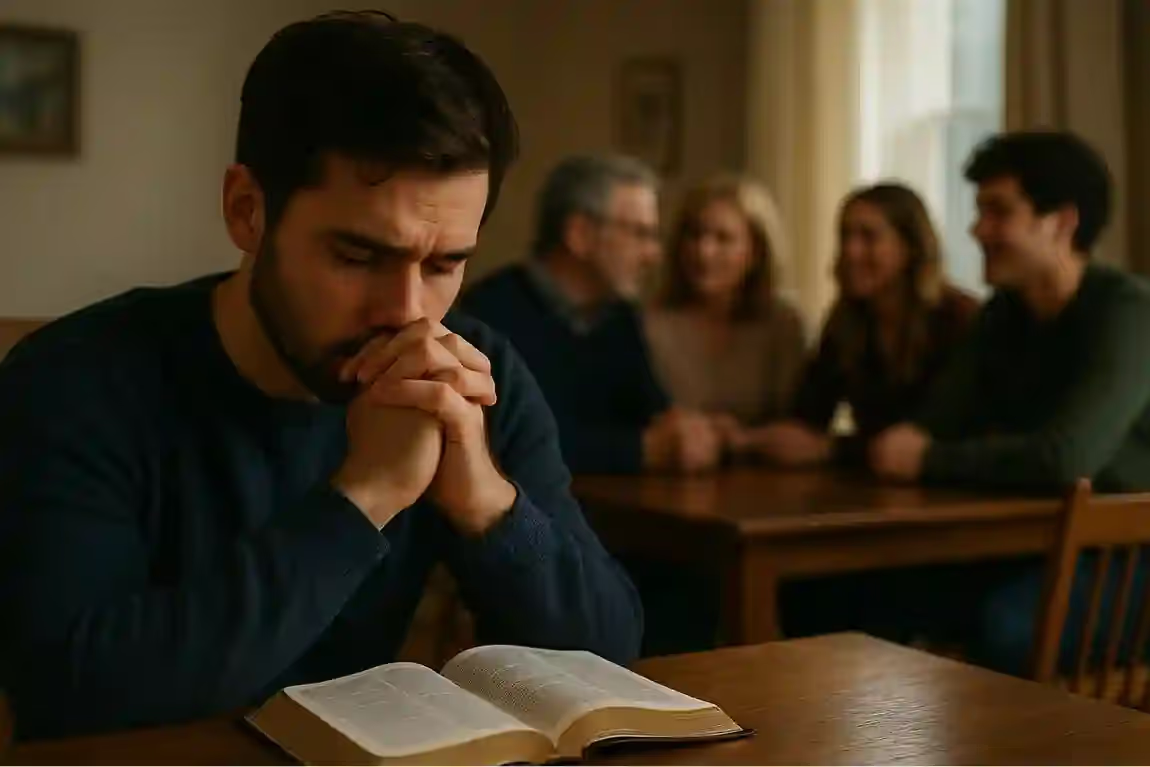
Rachel Kim sat alone in her childhood bedroom during Christmas break from college, listening to her family's laughter drifting up from downstairs where they were watching a movie together after dinner. She had excused herself early because the conversation had turned toward mocking religious people as ignorant and closed-minded, with her father making particularly pointed comments that Rachel could not help feeling were directed at her specifically even though he never mentioned her faith explicitly during these tirades that discomfort made unbearable eventually. Since Rachel had become a Christian during her freshman year at university, family gatherings had transformed from comfortable refuge into exhausting performance where she constantly monitored what she said, avoided topics that would trigger arguments about religion, and felt perpetually on guard against the criticism that any mention of her faith would inevitably produce from people who claimed to love her yet who seemed incapable of respecting the most important part of who she had become authentically.
The isolation felt overwhelming sometimes because the people she loved most in the world, the people whose approval mattered more than anyone else's, were the very people who either dismissed her faith as a phase she would outgrow eventually or who viewed it as weakness that education should have prevented her from embracing embarrassingly. Rachel maintained friendships with other Christians at school, attended church regularly there, and participated in campus ministry activities that community provided richly, yet none of this fully compensated for the loneliness she experienced at home where the people who knew her longest and deepest remained completely disconnected from the faith that now shaped everything about how she understood herself and the world fundamentally. She wondered how long she could sustain this division between her faith life and her family life, whether she should be more vocal about her beliefs despite knowing this would create conflict, and whether the gap between her and her family would only widen over time as her faith matured while their opposition remained entrenched stubbornly.
This article explores how believers can maintain strong faith when they are the only Christians in their families, addressing the unique challenges this situation creates and providing practical guidance for navigating the isolation, criticism, and relational complexity that being spiritually alone at home produces inevitably. Let me help you understand why this particular form of isolation hurts so deeply, show you how to stay strong in your faith despite lack of family support, and give you strategies for relating to your family with both love and integrity when differences seem insurmountable sometimes.
Before I show you how to navigate this difficult situation practically, I need you to understand why being the only believer in your family creates a particular type of pain that differs from other forms of spiritual isolation you might experience elsewhere. Think about what family represents in most people's lives, where these relationships provide your earliest and often most enduring connections, where you learned who you are through interaction with people who knew you before you could even speak, and where belonging feels fundamental rather than optional because blood ties create bonds that choice never established originally.
When your family does not share your faith, you experience disconnection at the deepest level of identity because the people who shaped you most profoundly remain outside the reality that now defines your entire worldview completely. Let me use a comparison that will help you see why this hurts so particularly. Imagine discovering something incredibly beautiful and transformative, like finding a cure for a disease that had plagued your family for generations, or like discovering that a place you had always dreamed about actually exists and is even more wonderful than you imagined. Now imagine trying to share this discovery with the people you love most, only to have them dismiss it as delusion, mock you for believing it, or simply refuse to engage with something they consider beneath serious consideration. The joy you feel about your discovery becomes contaminated by grief that the people you most want to share it with cannot or will not receive what you offer them genuinely.
Additionally, family dynamics create unique pressures that other contexts do not produce as intensely because family relationships involve power structures, shared history, and expectations about loyalty that questioning can feel like betrayal somehow even when independence represents healthy maturity rather than rejection. When you embrace faith that your parents did not raise you with, they may interpret this as criticism of their parenting or as rejection of the values they tried instilling in you carefully. When your faith leads you to make choices that differ from family norms around entertainment, relationships, spending, or priorities, these differences can feel like judgment even when you never intended communicating disapproval of their choices personally. Resources addressing family dynamics in faith contexts, like those from Billy Graham's guidance on being the only Christian in your family, can provide additional perspective on these challenges.
Let me break down the specific factors that make being the only believer in your family harder than being the only believer in your workplace, neighborhood, or friend group, because understanding these dynamics helps you recognize that your struggle is legitimate rather than something you should simply overcome through better attitude or stronger faith:
Now let me show you how scripture provides examples of believers who maintained faith despite being isolated from family or surrounded by people who did not share their convictions, because these stories demonstrate that your situation, while difficult, is neither unprecedented nor impossible to navigate faithfully. Think about Joseph, whose brothers hated him so intensely for his dreams and his father's favoritism that they sold him into slavery, yet who maintained faith in God throughout years of imprisonment and exile before eventually being restored to relationship with his family decades later. Joseph's story shows that faithfulness during family isolation often requires long-term perspective where you cannot see how God is working through the difficulty currently but where trust sustains you despite circumstances that abandonment might suggest more reasonably than providence does immediately. As scripture records in Genesis 50:20, Joseph eventually told his brothers that what they intended for harm, God intended for good, demonstrating that divine purposes can work through even the most painful family betrayals when we maintain faithfulness through the difficulty.
Consider Daniel and his friends who were taken from their families as teenagers and placed in a pagan culture that pressured them constantly to conform to practices and beliefs that conflicted with their faith fundamentally. They maintained faithfulness through creating community with each other, through small acts of obedience like dietary restrictions that seemed insignificant externally yet that signaled commitment internally, and through excelling in their work while never compromising their convictions about worship and allegiance that belonged to God alone ultimately. Shadrach, Meshach, and Abednego demonstrated that true faith remains steadfast even when threatened with death, declaring to King Nebuchadnezzar that whether God delivered them or not, they would not bow to the golden image. Their example shows that when family support is unavailable, building alternative community with other believers becomes crucial for sustaining faith that isolation would erode progressively without support that shared conviction provides naturally.
Think also about Timothy, whose father was apparently not a believer though his mother and grandmother were, creating household dynamics where faith was present but not universal across all family members. Paul encouraged Timothy to remember the sincere faith that lived in his grandmother Lois and his mother Eunice, suggesting that even partial family support matters significantly for sustaining belief when not everyone shares it equally. This pattern reminds us that God often provides support through some family members even when others remain opposed, and that these connections should be cultivated carefully as gifts that isolation alleviates partially even when complete family unity remains elusive currently. The family of God extends beyond biological relationships to include all believers who share faith in Christ.
Let me explain why creating robust Christian relationships beyond your family becomes absolutely essential rather than merely helpful when you lack faith support at home. Think about how you need people who understand your spiritual struggles, who pray with you about family situations, who remind you of truth when doubt creeps in through constant exposure to unbelief, and who celebrate spiritual growth that your family cannot appreciate fully because they do not share the framework for recognizing its significance accurately. This community might involve a local church where you participate actively beyond just Sunday attendance, a small group that meets regularly for deeper connection than large gatherings allow naturally, Christian friendships that you cultivate intentionally through shared activities and consistent contact, or mentoring relationships with more mature believers who can guide you through challenges that experience has taught them navigating successfully. The church family concept provides theological foundation for understanding why these relationships matter so profoundly for spiritual health. The key involves recognizing that this community is not optional luxury but rather necessary lifeline that sustains faith when isolation at home threatens eroding conviction progressively through lack of reinforcement that belief requires maintaining strongly over time.
Now let me show you why consistent personal spiritual disciplines become even more critical when you lack family support for your faith journey. When you live with other believers, their practices often prompt and reinforce your own through shared prayer before meals, through conversations about what you are reading in scripture, through reminders about church activities, and through countless other ways that cohabitation with fellow Christians naturally supports spiritual life without conscious effort required constantly. However, when you are the only believer in your household, nothing external prompts spiritual engagement unless you establish intentional rhythms that habit maintains regardless of whether you feel motivated on any particular day currently. This might involve setting specific times for prayer and scripture reading that schedule protects from intrusion, using apps or other tools that provide structure and accountability when human support remains unavailable naturally, journaling about your spiritual life to process experiences and track growth that isolation might otherwise prevent you from recognizing clearly, or engaging with online Christian content through podcasts, sermons, or teaching that input provides when conversation lacks it locally. The Bible verses about family can provide daily encouragement during these personal devotion times. These practices create stability that external circumstances cannot shake as easily because internal commitment sustains them through discipline that motivation alone would never maintain consistently across changing circumstances inevitably.
Let me help you understand an important spiritual lesson that your situation uniquely positions you to learn, which involves discovering that relationship with God can sustain and nourish you even when human support remains limited or absent entirely. Many believers never develop deep personal faith because they always have community carrying them along, where worship feels powerful primarily because of corporate energy, where Bible study happens mainly in groups, and where prayer occurs mostly with others rather than alone privately. However, when you lack Christian family, you must learn to encounter God directly through personal prayer that no one else hears, through scripture reading that no one else discusses with you immediately, and through worship that happens in your room alone rather than in services surrounded by hundreds of voices joining yours communally. This forced solitude can actually deepen your faith in ways that constant community sometimes prevents developing fully, because you discover that God meets you personally rather than only corporately, that scripture speaks directly to your situation without needing human interpretation mediating constantly, and that worship can be authentic even when no one witnesses it except the One to whom it is offered ultimately. Think of this like physical training where lifting weights alone builds different strength than team sports develop, with both having value but with solo practice creating capacities that group activities never demand building specifically.
Being the only believer in your family does not mean you are alone in your faith, because the global church extends across time and space to include millions of believers who understand your struggle intimately and who pray for those like you even without knowing your name specifically. More importantly, God himself promises presence that family cannot provide or withhold ultimately when divine companionship transcends human support completely.
Let me walk you through the delicate balance involved in maintaining both your faith integrity and your family relationships when these seem to conflict constantly through tensions that values differences create inevitably. The first principle involves recognizing that loving your family well actually constitutes powerful witness even when words never mention your faith explicitly, because the quality of your love, the patience you demonstrate when they criticize your beliefs, and the respect you show for them despite disagreement all communicate something true about the God you serve regardless of whether they acknowledge this connection consciously or not currently. Resources like Crosswalk's guidance on balancing love and conviction can provide practical wisdom for navigating these complex dynamics.
Think about what Jesus taught regarding loving enemies and praying for persecutors, principles that apply even more strongly to how you should treat family members who simply happen not to share your religious convictions yet. This means participating in family activities that do not require you to compromise your convictions, showing genuine interest in their lives and concerns, celebrating their successes authentically, supporting them through difficulties practically, and demonstrating that your faith makes you a better family member rather than a more difficult or self-righteous one that superiority would express offensively. When they see that following Jesus leads you to serve them more selflessly, to forgive more readily, to love more consistently, and to sacrifice more willingly than you did before faith transformed you, they learn something about Christianity that sermons alone could never teach as effectively through abstract propositions that experience illustrates more powerfully always.
At the same time, loving your family well does not mean hiding your faith completely or pretending to be someone you are not through editing out the aspects of your life that they find uncomfortable spiritually. You can mention church attendance, reference how prayer helps you, or explain how your faith influences decisions without preaching at them or making them feel judged for not sharing your beliefs similarly. The key involves natural honesty rather than either aggressive evangelism or complete concealment, where you live openly as a Christian while respecting their autonomy to respond to that reality however they choose freely without pressure that manipulation would apply coercively. Understanding what scripture teaches about household salvation can help calibrate expectations appropriately while maintaining hope for family members who do not yet believe.
Let me address situations where family members move beyond simply not sharing your faith into actively opposing it through mockery, criticism, or attempts to undermine your beliefs directly. This escalation changes the dynamic significantly because you must now maintain faith not just without support but against explicit resistance that discouragement seeks producing through constant pressure. First, recognize that you cannot control how your family responds to your faith, which means their opposition reflects their own struggles with spiritual matters rather than indicating failure on your part that different approach would resolve magically. You can control only your own faithfulness and how you respond to their opposition with grace rather than defensiveness that escalation would create destructively. Jesus himself acknowledged this reality when he said that a prophet is without honor in his own hometown and among his own family, validating the particular difficulty of maintaining faith among those who knew you before conversion transformed your identity fundamentally.
Second, establish boundaries around what topics you will engage regarding faith and what attempts at discussion you will decline participating in when they seem designed primarily to mock or undermine rather than to understand genuinely. You might say something like "I know you do not share my beliefs, and that is your choice. I am not trying to force my faith on you, but I also need you to respect that this is important to me even if you do not understand why." This response acknowledges difference without either demanding agreement or accepting disrespect as price for maintaining relationship that dignity requires protecting appropriately.
Third, recognize when opposition crosses into abuse that safety requires addressing through limiting contact or seeking outside help from pastors, counselors, or in extreme cases authorities who can intervene when family dynamics become damaging rather than merely difficult to navigate alone. Scripture commands honoring parents and maintaining family ties, but this does not require submitting to spiritual abuse or allowing family to damage your faith through constant attack that erosion produces progressively without protection that boundaries establish necessarily. Resources addressing spiritual dynamics in families can provide guidance for discerning when and how to establish protective boundaries wisely while maintaining as much relationship as health permits sustaining safely.
Let me provide specific guidance for common scenarios that believers in non-Christian families frequently encounter, because general principles require concrete application to become genuinely helpful in real situations that complexity makes challenging to navigate without specific direction. When family members mock your faith at gatherings, you have several options depending on the severity and context of the mockery. Minor teasing might be handled through gentle humor that defuses tension without either escalating conflict or abandoning your dignity entirely. More serious attacks might require either changing the subject gracefully, excusing yourself temporarily from the conversation, or in persistent cases stating clearly that you will not continue participating in discussion that treats your beliefs with contempt rather than respect.
When parents pressure you to participate in activities that conflict with your convictions, whether religious observances from other traditions, entertainment you find objectionable, or social situations involving behaviors you have committed to avoiding, you must balance honoring your parents with honoring God whose commands take precedence when these conflict directly. This might involve explaining your convictions respectfully, offering alternatives that accomplish the relational goals without violating your conscience, or in some cases simply declining participation while expressing love and appreciation for the relationship that disagreement on this point does not negate entirely. The question of honoring parents while following Christ requires wisdom that recognizes both commands as valid while understanding which takes precedence in specific situations where they seem to conflict.
Let me help you understand how the concept of spiritual family provides genuine support that biological family's lack of faith creates unavoidably when isolation threatens overwhelming you despite your best efforts at maintaining strong personal faith independently. Think about how Jesus redefined family in spiritual terms when he pointed to his disciples and said that whoever does the will of God is his brother, sister, and mother, thereby establishing that spiritual kinship can be just as real and significant as biological relationships that blood creates naturally. This principle means that the church should function as family for believers, providing the support, accountability, encouragement, and belonging that everyone needs for thriving but that not everyone receives from biological relatives who share genes without sharing faith ultimately.
Practically, this involves intentionally building relationships within your church community that go deeper than surface-level friendliness, where you share your struggles honestly and receive prayer and practical support during difficult seasons that spiritual family navigates alongside you faithfully. This might mean identifying a few older believers who can serve as spiritual parents providing guidance that your actual parents cannot offer when they do not share your faith convictions. It might involve finding peers who understand your situation and who encourage you regularly through friendship that isolation alleviates partially. It might mean serving others in the church family in ways that create reciprocal relationships where giving and receiving happen naturally rather than one-sidedly. The biblical teaching on being part of God's family establishes the theological foundation for these relationships that meet needs biological family cannot address when spiritual disconnection prevents the support that shared faith enables naturally.
However, I want to emphasize that spiritual family should complement rather than replace biological family when possible, because God's design includes both kinds of relationships serving different purposes that wholeness requires honoring simultaneously when circumstances allow maintaining both faithfully. You should not abandon your biological family emotionally just because they do not share your faith, but rather should recognize that spiritual family provides what biological family cannot while continuing to love and maintain connection with biological relatives as much as health and wisdom permit navigating these complex relational dynamics carefully.
Let me address the tension between accepting your family as they are currently and maintaining hope that they might eventually embrace the faith you hold dear, because this tension creates ongoing emotional complexity that requires wisdom to navigate without either despair or presumption. On one hand, you must accept that your family members are autonomous individuals who have the right to make their own spiritual decisions, which means you cannot force conversion no matter how much you pray, witness, or live faithfully before them. This acceptance protects you from the exhausting burden of feeling responsible for their salvation, which belongs to God alone who draws people to himself through means that often remain mysterious to human observation.
On the other hand, scripture encourages persistent prayer for those who do not yet believe, and many testimonies demonstrate that family members sometimes come to faith years or even decades after initial prayers began on their behalf. This means you can maintain hope without either demanding immediate results or assuming that continued resistance indicates permanent rejection that God cannot overcome eventually. Some believers have prayed for family members for twenty, thirty, or even forty years before seeing breakthrough that persistence had sustained hoping for despite all evidence suggesting futility. Your prayers matter even when you cannot see their effects immediately, and your faithful life provides ongoing witness that God can use at any moment to awaken spiritual interest that previous exposure had planted as seeds awaiting later germination.
The key involves holding hope and acceptance together, where you continue praying and hoping while simultaneously loving your family well regardless of whether they ever convert. This means not making your love for them conditional on their spiritual response, not treating every interaction as evangelistic opportunity that relationship serves instrumentally, and not communicating through either words or attitude that their current spiritual state makes them less valuable or lovable to you than they would be if they shared your faith. Your unconditional love itself witnesses to the nature of the God you serve, who loved humanity while we were still sinners rather than waiting until we deserved his affection through righteousness we could never achieve independently.

Rachel Kim from our opening story eventually learned to navigate the tension between her biological family and her faith through building strong Christian community at school while also finding ways to love her family well despite their opposition to her beliefs. She stopped trying to force spiritual conversations with her parents and siblings when these attempts only created arguments that distance increased rather than understanding that connection would build naturally. Instead, she focused on being exceptionally kind, helpful, and present during family time, demonstrating through actions that her faith made her a better daughter and sister rather than a more difficult or judgmental one that criticism assumed her becoming inevitably.
At school, Rachel invested deeply in relationships with other Christians who could support her spiritual growth in ways her family could not, joining a small group that met weekly for prayer and Bible study, developing close friendships with several women who understood her struggles with family opposition intimately, and connecting with a campus minister who served as spiritual mentor providing guidance that her parents could not offer when they dismissed faith as weakness rather than recognizing it as strength that maturity demonstrated courageously. These relationships became lifeline that sustained her faith during holiday breaks at home when isolation threatened overwhelming her despite intellectual conviction that belief remained true regardless of whether her family shared it eventually.
Five years after becoming a Christian, Rachel's family still did not share her faith, and she had learned to accept this reality without abandoning hope that they might eventually embrace Christianity through witnessing her transformed life over decades rather than through arguments that persuasion never accomplished effectively anyway. Her relationship with her family had actually improved once she stopped trying to convince them and started simply loving them well while maintaining her own faith commitments privately. They still made occasional comments about religion that hurt her feelings, but Rachel had developed thicker skin through recognizing that their opposition reflected their own spiritual blindness rather than her failure that self-blame would internalize unnecessarily.
Most importantly, Rachel had discovered that being the only believer in her family, while painful and lonely at times, had actually forced her to develop deeper personal faith than she might have if surrounded by Christian family who would have provided easy support that growth sometimes requires struggling without when independence must develop through necessity rather than through choice that comfort would select preferentially always. Her faith had been tested and proven genuine through the fire of family opposition, and this testing had produced strength that easier circumstances would never have demanded she develop so thoroughly. She had learned that God's grace truly is sufficient, that his power is made perfect in weakness, and that the isolation she experienced at home had become classroom where lessons about dependence on God were taught more effectively than any church program could have provided through instruction that experience always teaches more profoundly than words alone communicate abstractly.
Rachel also discovered that her experience positioned her uniquely to minister to others facing similar situations, where she could offer understanding and practical guidance that those raised in Christian families simply could not provide from their different experience. She began leading a support group at her church for believers from non-Christian families, creating community for others walking the same difficult path she had learned to navigate through years of trial and error that wisdom now allowed her to share generously. What had felt like curse initially had become calling, where the very difficulty that had caused her so much pain now enabled her to help others whose struggles she understood intimately because she had lived them herself rather than merely studying them academically.
The journey continues for Rachel and for everyone walking similar paths of faith amid family opposition. There are still difficult moments when the longing for family understanding becomes almost unbearable, still seasons when doubt whispers that maybe her family is right about religion being weakness or delusion. But Rachel has learned to bring these struggles to God in prayer, to her spiritual community for support, and to scripture for truth that anchors her soul regardless of what circumstances or emotions suggest temporarily. She has discovered that being the only believer in her family, while never becoming easy, has become bearable and even meaningful as God works through her situation for purposes that extend far beyond her individual comfort to include eternal significance that temporal difficulty cannot diminish ultimately. The isolation that once threatened destroying her faith has become the very context within which that faith has grown strongest, proving true the promise that God works all things together for good for those who love him and are called according to his purpose that family opposition cannot thwart when divine faithfulness sustains believers through every circumstance that life brings inevitably.
As we conclude this exploration of maintaining faith as the only believer in your family, let me leave you with several essential truths that you can return to whenever discouragement threatens overwhelming your resolve to remain faithful despite the unique challenges your situation creates. First, remember that your worth and identity come from God rather than from your family's acceptance of your faith. Their rejection or criticism of your beliefs does not diminish your value as God's beloved child, nor does their approval determine whether your faith is genuine or your spiritual choices are wise. You belong to the family of God through faith in Christ, and this spiritual belonging provides security that human acceptance can never establish or remove regardless of how desperately you might wish your biological family understood and embraced your faith alongside you.
Second, remember that your faithfulness matters to God even when it produces no visible results in your family's spiritual condition. Scripture consistently teaches that God rewards faithfulness rather than success, that obedience pleases him regardless of outcomes that remain beyond your control, and that eternal evaluation will consider not whether your family converted but whether you loved them well and maintained your own integrity through the difficulty. Third, remember that you are part of a vast community of believers throughout history who have faced similar challenges and who have proven that faith can survive and even thrive despite family opposition that isolation would suggest should destroy it. The saints who have gone before you include countless individuals who maintained faith without family support, and their testimonies encourage us that what seems impossible to human strength becomes possible through divine grace that sustains believers through every circumstance imaginable.
Fourth, remember that God's sovereignty extends over your family situation just as it extends over everything else in creation. Your position as the only believer in your family is not accident or mistake but rather assignment that God has permitted for purposes that include both your growth and possibly your family's eventual salvation through means you cannot predict or control. Trust that the same God who saved you is capable of saving your family if and when he chooses, and that your faithfulness serves his purposes regardless of whether you ever see the results during your lifetime on earth.
Finally, remember that heaven awaits where all isolation will end, all relationships will be restored or replaced with something better, and all the difficulty of maintaining faith without family support will fade into insignificance compared to the eternal glory that faithful endurance produces through temporary suffering that produces permanent reward beyond anything we can currently imagine or anticipate adequately.
NOVEMBER 25, 2025
NOVEMBER 25, 2025
NOVEMBER 25, 2025
NOVEMBER 24, 2025
NOVEMBER 24, 2025